Friday, December 23, 2016

Borderline Personality Disorder (BPD) — Out of the FOG

Borderline Personality Disorder (BPD) — Out of the FOG

Borderline Personality Disorder (BPD)

Introduction

Borderline Personality Disorder is a serious condition which is estimated to affect between 1-3% of the general population. Yet, despite being so prevalent, BPD is not commonly known about or understood.

People who live in a relationship with a person who suffers from borderline personality disorder often know that something is terribly wrong with the behavior of their family member or loved-one but often do not know what to do about it, or that there is even a name for it.

Alternate Names for BPD

There are a number of different names used around the world for Borderline Personality Disorder:

  • Borderline Personality Disorder (BPD)
  • Emotional Regulation Disorder (ERD)
  • Emotional Dysregulation Disorder
  • Emotional Intensity Disorder (EID)
  • Emotionally Unstable Personality Disorder (EUPD)
  • Emotion-Impulse Regulation Disorder (EIRD)
  • Impulsive Personality Disorder (IPD)

The most commonly used name today is Borderline Personality Disorder - or BPD - as defined in the American Psychiatric Association's Diagnostic & Statistical Manual (DSM-IV-TR).

The term "Borderline" is a historic term coined to describe people who were diagnosed to be on the borderline between a neurotic and psychotic disorder. It is commonly felt that the "Borderline" label is misleading and stigmatizes the disorder. 

Borderline Personality Disorder (BPD) - The DSM Criteria

Borderline Personality Disorder (BPD) is listed in the American Psychiatric Association's Diagnostic & Statistical Manual (DSM) as an Axis II, Cluster B (dramatic, emotional, or erratic) Disorder:

A pervasive pattern of instability of interpersonal relationships, self-image, and affects, and marked impulsivity beginning by early adulthood and present in a variety of contexts, as indicated by five (or more) of the following:

  1. Frantic efforts to avoid real or imagined abandonment. [Not including suicidal or self-mutilating behavior covered in Criterion 5]
  2. A pattern of unstable and intense interpersonal relationships characterized by alternating between extremes of idealization and devaluation.
  3. Identity disturbance: markedly and persistently unstable self-image or sense of self.
  4. Impulsivity in at least two areas that are potentially self-damaging (e.g., spending, promiscuous sex, eating disorders, substance abuse, reckless driving, binge eating). [Again, not including suicidal or self-mutilating behavior covered in Criterion 5]
  5. Recurrent suicidal behavior, gestures, or threats, or self-mutilating behavior.
  6. Affective instability due to a marked reactivity of mood (e.g., intense episodic dysphoria, irritability, or anxiety usually lasting a few hours and only rarely more than a few days)
  7. Chronic feelings of emptiness.
  8. Inappropriate, intense anger or difficulty controlling anger (e.g., frequent displays of temper, constant anger, recurrent physical fights).
  9. Transient, stress-related paranoid ideation or severe dissociative symptoms.

Characteristics & Traits

The following list is a collection of some of the more commonly observed behaviors and traits of those who suffer from BPD. Click on the links on each one for more information about a particular trait or behavior and some ideas for coping with each.

Note that these traits are given as a guideline only and are not intended for diagnosis. People who suffer from BPD are all unique and so each person will display a different subset of traits. Also, note that everyone displays "borderline" behaviors from time to time. Therefore, if a person exhibits one or more of these traits, that does not necessarily qualify them for a diagnosis of BPD. See the DSM Criteria on this page for diagnostic criteria.

Abusive Cycle - This is the name for the ongoing rotation between destructive and constructive behavior which is typical of many dysfunctional relationships and families.

Alienation - The act of cutting off or interfering with an individual's relationships with others.

"Always" and "Never" Statements - "Always" and "Never" Statements are declarations containing the words "always" or "never". They are commonly used but rarely true.

Anger - People who suffer from personality disorders often feel a sense of unresolved anger and a heightened or exaggerated perception that they have been wronged, invalidated, neglected or abused.

Baiting - A provocative act used to solicit an angry, aggressive or emotional response from another

Blaming - The practice of identifying a person or people responsible for creating a problem, rather than identifying ways of dealing with the problem.

Bullying - Any systematic action of hurting a person from a position of relative physical, social, economic or emotional strength.

Catastrophizing - The habit of automatically assuming a "worst case scenario" and inappropriately characterizing minor or moderate problems or issues as catastrophic events.

Chaos Manufacture - Unnecessarily creating or maintaining an environment of risk, destruction, confusion or mess.

Cheating - Sharing a romantic or intimate relationship with somebody when you are already committed to a monogamous relationship with someone else.

Chronic Broken Promises - Repeatedly making and then breaking commitments and promises is a common trait among people who suffer from personality disorders.

Circular Conversations - Arguments which go on almost endlessly, repeating the same patterns with no resolution.

Confirmation Bias - The tendency to pay more attention to things which reinforce your beliefs than to things which contradict them.

"Control-Me" Syndrome - This describes a tendency which some people have to foster relationships with people who have a controlling narcissistic, antisocial or "acting-out" nature.

Denial - Believing or imagining that some painful or traumatic circumstance, event or memory does not exist or did not happen.

Dependency - An inappropriate and chronic reliance by an adult individual on another individual for their health, subsistence, decision making or personal and emotional well-being.

Depression - People who suffer from personality disorders are often also diagnosed with symptoms of depression.

Dissociation- A psychological term used to describe a mental departure from reality.

Domestic Theft - Consuming or taking control of a resource or asset belonging to (or shared with) a family member, partner or spouse without first obtaining their approval.

Emotional Abuse - Any pattern of behavior directed at one individual by another which promotes in them a destructive sense of Fear, Obligation or Guilt (FOG).

Emotional Blackmail - A system of threats and punishments used in an attempt to control someone's behaviors.

Engulfment - An unhealthy and overwhelming level of attention and dependency on another person, which comes from imagining or believing one exists only within the context of that relationship.

False Accusations - Patterns of unwarranted or exaggerated criticism directed towards someone else.

Favoritism and Scapegoating - Systematically giving a dysfunctional amount of preferential positive or negative treatment to one individual among a family group of peers.

Fear of Abandonment - An irrational belief that one is imminent danger of being personally rejected, discarded or replaced.

Feelings of Emptiness - An acute, chronic sense that daily life has little worth or significance, leading to an impulsive appetite for strong physical sensations and dramatic relationship experiences.

Gaslighting - The practice of brainwashing or convincing a mentally healthy individual that they are going insane or that their understanding of reality is mistaken or false. The term "Gaslighting" is based on the 1944 MGM movie "Gaslight".

Harassment - Any sustained or chronic pattern of unwelcome behavior by one individual towards another.

Holiday Triggers - Mood Swings in Personality-Disordered individuals are often triggered or amplified by emotional events such as family holidays, significant anniversaries and events which trigger emotional memories.

Hoovers & Hoovering - A Hoover is a metaphor taken from the popular brand of vacuum cleaners, to describe how an abuse victim trying to assert their own rights by leaving or limiting contact in a dysfunctional relationship, gets "sucked back in" when the perpetrator temporarily exhibits improved or desirable behavior.

Hysteria - An inappropriate over-reaction to bad news or disappointments, which diverts attention away from the real problem and towards the person who is having the reaction.

Identity Disturbance - A psychological term used to describe a distorted or inconsistent self-view

Imposed Isolation - When abuse results in a person becoming isolated from their support network, including friends and family.

Impulsiveness - The tendency to act or speak based on current feelings rather than logical reasoning.

Infantilization - Treating a child as if they are much younger than their actual age.

Intimidation - Any form of veiled, hidden, indirect or non-verbal threat.

Invalidation - The creation or promotion of an environment which encourages an individual to believe that their thoughts, beliefs, values or physical presence are inferior, flawed, problematic or worthless.

Lack of Conscience - Individuals who suffer from Personality Disorders are often preoccupied with their own agendas, sometimes to the exclusion of the needs and concerns of others. This is sometimes interpreted by others as a lack of moral conscience.

Lack of Object Constancy - An inability to remember that people or objects are consistent, trustworthy and reliable, especially when they are out of your immediate field of vision.

Low Self-Esteem - A common name for a negatively-distorted self-view which is inconsistent with reality.

Manipulation - The practice of steering an individual into a desired behavior for the purpose of achieving a hidden personal goal.

Masking - Covering up one's own natural outward appearance, mannerisms and speech in dramatic and inconsistent ways depending on the situation.

Mirroring - Imitating or copying another person's characteristics, behaviors or traits.

Moments of Clarity - Spontaneous periods when a person with a Personality Disorder becomes more objective and tries to make amends.

Mood Swings - Unpredictable, rapid, dramatic emotional cycles which cannot be readily explained by changes in external circumstances.

Munchausen's and Munchausen by Proxy Syndrome - A disorder in which an individual repeatedly fakes or exaggerates medical symptoms in order to manipulate the attentions of medical professionals or caregivers.

Name-Calling - Use of profane, derogatory or dehumanizing terminology to describe another individual or group.

Neglect - A passive form of abuse in which the physical or emotional needs of a dependent are disregarded or ignored by the person responsible for them.

"Not My Fault" Syndrome - The practice of avoiding personal responsibility for one's own words and actions.

No-Win Scenarios - When you are manipulated into choosing between two bad options

Objectification - The practice of treating a person or a group of people like an object.

Obsessive-Compulsive Behavior - An inflexible adherence to arbitrary rules and systems, or an illogical adherence to cleanliness and orderly structure.

Panic Attacks - Short intense episodes of fear or anxiety, often accompanied by physical symptoms, such as hyperventilating, shaking, sweating and chills.

Parental Alienation Syndrome - When a separated parent convinces their child that the other parent is bad, evil or worthless.

Parentification - A form of role reversal, in which a child is inappropriately given the role of meeting the emotional or physical needs of the parent or of the family's other children.

Passive-Aggressive Behavior - Expressing negative feelings in an unassertive, passive way.

Pathological Lying - Persistent deception by an individual to serve their own interests and needs with little or no regard to the needs and concerns of others. A pathological liar is a person who habitually lies to serve their own needs.

Perfectionism - The maladaptive practice of holding oneself or others to an unrealistic, unattainable or unsustainable standard of organization, order, or accomplishment in one particular area of living, while sometimes neglecting common standards of organization, order or accomplishment in other areas of living.

Projection - The act of attributing one's own feelings or traits to another person and imagining or believing that the other person has those same feelings or traits.

Proxy Recruitment - A way of controlling or abusing another person by manipulating other people into unwittingly backing "doing the dirty work"

Push-Pull - A chronic pattern of sabotaging and re-establishing closeness in a relationship without appropriate cause or reason.

Raging, Violence and Impulsive Aggression - Explosive verbal, physical or emotional elevations of a dispute. Rages threaten the security or safety of another individual and violate their personal boundaries.

Relationship Hyper Vigilance - Maintaining an unhealthy level of interest in the behaviors, comments, thoughts and interests of others.

Riding the Emotional Elevator - Taking a fast track to different levels of emotional maturity.

Sabotage - The spontaneous disruption of calm or status quo in order to serve a personal interest, provoke a conflict or draw attention.

Scapegoating - Singling out one child, employee or member of a group of peers for unmerited negative treatment or blame.

Selective Memory and Selective Amnesia - The use of memory, or a lack of memory, which is selective to the point of reinforcing a bias, belief or desired outcome.

Selective Competence - Demonstrating different levels of intelligence, memory, resourcefulness, strength or competence depending on the situation or environment.

Self-Harm - Any form of deliberate, premeditated injury, such as cutting, poisoning or overdosing, inflicted on oneself.

Self-Loathing - An extreme hatred of one's own self, actions or one's ethnic or demographic background.

Self-Victimization - Casting oneself in the role of a victim.

Sense of Entitlement - An unrealistic, unmerited or inappropriate expectation of favorable living conditions and favorable treatment at the hands of others.

Shaming - The difference between blaming and shaming is that in blaming someone tells you that you did something bad, in shaming someone tells you that you are something bad.

Silent Treatment - A passive-aggressive form of emotional abuse in which displeasure, disapproval and contempt is exhibited through nonverbal gestures while maintaining verbal silence.

Situational Ethics - A philosophy which promotes the idea that, when dealing with a crisis, the end justifies the means and that a rigid interpretation of rules and laws can be set aside if a greater good or lesser evil is served by doing so.

Sleep Deprivation - The practice of routinely interrupting, impeding or restricting another person's sleep cycle.

Splitting - The practice of regarding people and situations as either completely "good" or completely "bad".

Stalking - Any pervasive and unwelcome pattern of pursuing contact with another individual.

Stunted Emotional Growth - A difficulty, reluctance or inability to learn from mistakes, work on self-improvement or develop more effective coping strategies.

Testing - Repeatedly forcing another individual to demonstrate or prove their love or commitment to a relationship.

Thought Policing - Any process of trying to question, control, or unduly influence another person's thoughts or feelings.

Threats - Inappropriate, intentional warnings of destructive actions or consequences.

Triangulation - Gaining an advantage over perceived rivals by manipulating them into conflicts with each other.

Triggering -Small, insignificant or minor actions, statements or events that produce a dramatic or inappropriate response.

Tunnel Vision - The habit or tendency to only see or focus on a single priority while neglecting or ignoring other important priorities.

Verbal Abuse - Any kind of repeated pattern of inappropriate, derogatory or threatening speech directed at one individual by another.

BPD Statistics

An estimated 2% of the US population is estimated to meet the clinical criteria for BPD. However, prevalence results vary widely as shown below. A number of studies have been performed to determine the prevalence of personality disorders and BPD. Prevalence results indicate that BPD affects anywhere between 0.5 and 5.9% of adults

People who have a first-degree relative with BPD are five times more likely to develop BPD themselves. Those who suffer child abuse are also more likely to develop BPD.

Some people who suffer from BPD are prone to suicidal behaviors and self-injury, especially as adolescents. About 8%-10% of diagnosed BPD patients commit suicide.

See Our Statistics section for more statistics on Personality Disorders.

Click here for some statistics on the possible origins of BPD.

BPD Treatment

There is no known cure for BPD. As a result, families of people who suffer from BPD are often left to fend for themselves and rely on their own resources.

However, some treatments do exist which have proven effective in managing symptoms. The most common approach is the combination of SSRI medication and DBT Therapy.

Dialectical Behavioral Therapy - Dialectical Behavioral Therapy (DBT) is a psychosocial treatment which combines intensive individual and group therapy.

SSRI's - Selective Serotonin Reuptake Inhibitors. Popular SSRI's include Celexa, Lexapro, Prozac, Paxil, & Zoloft.

BPD Possible Causes

The causes for BPD are not precisely known. However, recent research has turned up some clues. Further study is necessary to definitively establish a cause. However, theories do exist.

There is some evidence relating the prevalence of BPD to the kind of environment a child grew up in. A significant percentage of people who suffer from BPD were also abused as children. However, this kind of correlation does not always prove that the environment they grew up in contributed to their own disorder.

There is a higher incidence of personality disorders in those who have parents who suffer from a personality disorder. This has led some scientists to suspect there may be a genetic link for BPD.

BPD is more commonly diagnosed in females than males. Read our section on the Amygdala for some information on gender differences in neural activity which may some day lead to a greater understanding of why certain disorders may afflict one gender more than another.

The Amygdala and it's Link to BPD

The Amygdala is a small region of the brain which plays a key role in emotional regulation, emotional memory and responses to emotional stimuli.

Recent technological advances have given neurologists two new ways to create 3-D images of the brain. These techniques are known as Positron Emission Tomography (PET Scanning) and functional Magnetic Resonance Imaging (fMRI). By scanning a person's brain while prompting them to think in a certain way, scientists are unlocking clues as to which regions of the brain are responsible for different kinds of thought.

Much of this work has focused on the amygdala - a small region deep in the brain shown below. There is one amygdala the right side of the brain and one on the left.
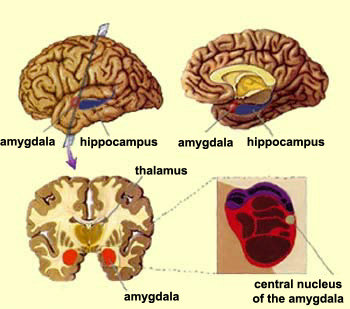
The Amygdala, courtesy The Brain From Top To Bottom @ http://thebrain.mcgill.ca/

The Amygdala's Role in Emotional Reactions

It is believed that the amygdala has an important rule in producing lightning-fast emotional responses to events, whenever a person recognizes an event with a strong emotional element (good or bad) such as events that results in fear, anger or rage or events that result in delight, joy or excitement.

The amygdala is believed to be part of our fast, instinctive and reactive brains. Not much conscious thought is involved if an object is hurled towards us and we instinctively duck. This ability to react instinctively to danger is thought to have historically played a critical function in survival of most species. Similarly, witness the reaction of a crowd whenever a sports team scores a goal. There is a universal instant response of throwing hands in the air, widening the eyes, leaping into the air etc, without much thought given. When you see these instinctive reactions occur, the amygdala is at work.

The Amygdala and Memory

The amygdala has also been shown to have an important function in enhancing memory functions by releasing stress hormones, such as adrenaline. It has been shown experimentally that rats, who have had their amygdala disabled lose their fear of cats. It has also been shown that increasing stress hormones improves memory of an event. This helps explain why people can remember stressful moments in great detail - such as times of disasters or crises, when adrenaline is released and yet can easily forget long periods when nothing significant seems to have happened.

Gender Differences in the Way the Amygdala is Connected

Another interesting finding resulted from a study comparing amygdala activity in males and females. When shown images containing strong emotionally arousing content, it was found that the amygdala on the right side of the brain was the most active in men, while the amygdala on the left side of the brain was most active in women.

Other experiments with people who are relaxing have shown that in men, the right amygdala is more closely connected to the rest of the brain than the left, while women show a stronger connectivity between the left amygdala and the rest of the brain. Additionally, in men the right amygdala seems to be strongly connected to regions of the brain normally associated with interactions with the external environment while in women, the left amygdala seems to be strongly connected to regions of the brain normally associated with more internal thought. This suggests that in an emotional context, men are biased toward thoughts about the external environment and women toward thoughts about the internal environment.

Source: Human Brain Imaging Studies of Emotional Memory: Uncovering Influences of Sex and Hemisphere by Larry Cahill.

The Link between the Amygdala and Emotional Regulation Disorder / Borderline Personality Disorder

In a famous experiment at Yale University, 15 people diagnosed with BPD and 15 people with no BPD diagnosis were shown photographs of faces with neutral, happy, sad, and fearful facial expressions while mapping the activity in the brain using fMRI. It was found that there is a lot more activity in the left amygdala of people who had been diagnosed with Borderline Personality Disorder when exposed to an emotional stimulus than there is for most other people.

Source: Donegan et al, Amygdala hyperreactivity in borderline personality disorder: implications for emotional dysregulation.

BPD vs. Bipolar Disorder

Borderline Personality Disorder (BPD) and Bipolar Disorder are similar in that both are characterized by dramatic changes in mood. It is thought that many people who suffer from BPD are inaccurately diagnosed as having Bipolar disorder because it generally carries less stigma and is easier to treat with pharmaceuticals. However, there are also some important differences between Bipolar & BPD:

Frequency of Mood Cycles

Mood swings for people who suffer from Borderline Personality Disorder typically cycle much faster than for people who suffer from Bipolar Disorder. BPD sufferers often exhibit mood cycles lasting from a few hours to a few days. People who suffer from Bipolar Disorder typically exhibit mood swings lasting from a few weeks to a few months.

It should be noted that some Bipolar patients are characterized or diagnosed with Rapid Cycling Bipolar Disorder which has the same symptoms as Bipolar Disorder but with a shorter cycle time.

Relationship Basis

People who suffer from BPD often exhibit an acute Fear of Abandonment. The mood swings a person with BPD exhibits are often attached to their fear of being left alone or their preoccupation with not being alone. Sometimes, BPD is described as a "relationship disorder" in that it manifests itself in interactions with others.

Bipolar Disorder tends to be less relationship-based. People who suffer from Bipolar Disorder often display cycles of mood which are more inwardly self-focused and have less to do with how they feel about the relationships they are involved in.

Dissociation

Borderline Personality Disorder comprises both psychotic & neurotic thought processes. This gives rise to the name "Borderline" because it is thought to be on the "borderline" between psychosis & neurosis. The thinking and behavior of a person with Borderline Personality Disorder includes more mental departures from reality, known as Dissociation or "feelings create facts".

In contrast, Bipolar Disorder tends to be more neurotic in that the mood swings tend to be based more on extreme exaggerations of fact.

Response To Treatment

People who suffer from Bipolar Disorder often respond positively to appropriate regimes of medication.

People who suffer from Borderline Personality Disorder may also exhibit some improvement when treated with appropriate medication but typically also require extensive therapeutic intervention such as DBT over a period of months or years in order to see comparable results.

Both groups are often reluctant to seek help and may be resistant to medication. Also, both groups have a tendency to stop taking prescribed medications when they begin to feel better which often leads to relapses.

Movies Portraying Borderline Personality Disorder Traits

A Streetcar Named Desire - A Streetcar Named Desire is a is a 1947 play written by Tennessee Williams, later adapted for film, which tells the story of a woman who displays histrionic and borderline traits, who goes to live with her codependent sister and her narcissistic husband.

Fatal Attraction - Fatal Attraction is a 1987 Movie Thriller starring Glenn Close & Michael Douglas about Dan Gallagher, a New York Lawyer (played by Michael Douglas) who is stalked by Alex Forrest (played by Glenn Close) with whom he has had an affair. The story portrays Alex's increasingly unstable behavior as a result of having Borderline Personality Disorder and feeling abandoned by Dan.

Girl, Interrupted - Girl, Interrupted is a 1999 Columbia Pictures movie which chronicles the experiences of a teenage girl with Borderline Personality Disorder, who is admitted to a mental health institution after attempting suicide.

Mommie Dearest - Mommie Dearest is a 1981 biography of Hollywood Actress Joan Crawford, played by Faye Dunaway, who, according to the account in the movie, exhibited Obsessive Compulsive, Borderline and Narcissistic Traits.

Single White Female - Single White Female is a 1992 Columbia Pictures Release starring Bridget Fonda and Jennifer Jason Leigh which portrays the events after a young woman takes in a roommate who exhibits some of the symptoms of Borderline Personality Disorder (BPD) and Dependent Personality Disorder (DPD) including mirroring, impulsivity and fear of abandonment.

The Wizard of Oz - The Wizard of Oz is a 1944 movie starring Judy Garland which is sometimes used as a metaphor to describe the disconnect between the dissociated reality of the personality-disordered individual (Oz) and the real world experienced by the Non-PD (Kansas). The metaphor is based on the iconic phrase: "Toto - I've a feeling we're not in Kansas any more".

BPD Support Groups & Links:

Psychforums BPD forum - Psychforums Site.

Anything to Stop The Pain - information site, blog and support board for Non-Borderlines, with a particular emphasis on supporting people who have children with BPD and people in a committed relationship with a person who suffers from BPD.

Emergence - http://www.emergenceplus.org.uk - UK site with personality disorder related information and services.

http://borderlinepersonality.ca/board BPD Support Site run by BPD Author A. J. Mahari.

http://www.BPDCentral.com - An information and support site about BPD run by Randi Kreger, co-author of "Stop Walking on Eggshells".


^ed 

Wednesday, December 21, 2016

In God We Trust: Applying the Lemon Test for Public Funds for Parochial Schools

Sanity for Superheroes: In God We Trust: Applying the Lemon Test for Public Funds for Parochial Schools


In God We Trust: Applying the Lemon Test for Public Funds for Parochial Schools

In God We Trust:  The Lemon Test and Public Funds for Parochial Schools 

Elyssa Durant 

Guiding Questions 

 1. How can school vouchers reach a balance between serving the public interest and preserving individual freedoms and rights?  

2. What additional arguments can be presented for against the use of school vouchers for parochial schools? 

3. How is the issue of school vouchers for sectarian institutions different or similar from issues surrounding prayer in school? 

4. What are the common issues relevant to both charter schools and voucher programs? 


 This article will address concerns regarding the long-term outcomes of school choice and voucher programs. Specifically: do school vouchers exacerbate the inequality between the rich and the poor? Since I believe that health care and education are both social goods, I have some reservations about letting the free-market run amok during such a critical point in history. Is it wise to allow for-profit market forces to dictate public goods when natural rights are at stake?  The shortcomings of the Medicaid managed care programs, Medicare supplemental insurance policies, and demonstration projects such as the privatization of prisons provide sufficient evidence of the dangers of profit driven corporations in American culture. Corporate scandals with food and other suppliers contracted by the Board of Education in New York City in the late 1990's provide excellent examples of how easy it is for private companies to manipulate funds away from the target recipients. It was not too long ago that private managed care companies offered gifts to boost enrollment by enticing desperate Medicaid recipients to join their plans. This marketing strategy is simply offensive when we are dealing with a social good albeit health care or education. Vulnerable populations are frequently exploited through corporate contracts and there is little reason to believe that for-profit conglomerates would treat public schools or economically disadvantaged students and families otherwise. Arguments on both sides of the school voucher issue are very similar to those presented for and against charter schools and free-market school choice. Smrekar (1998) presents four key issues that have been at the center of the school choice debate: (1) economic, (2) political; (3) social justice; and (4) pedagogical. The economic argument in favor of school choice points out that our current public education system resembles a monopoly. Proponents argue that the introduction of choice into the educational marketplace will promote competition and force schools with poor performance records to improve or close (Friedman, 1968). The political argument is centered on the democratic ideal that the freedom to choose where your child attends school is a fundamental right. The political argument also triggers strong feelings about the role of education in a democratic society. There are those who feel that the public school is intended, at least in part, to create a common set of core values that is best served by the public sector.  At the core of the political school choice argument is a debate regarding the benefits of providing a common set of experiences in a democracy versus promoting individual choice and liberty (Smrekar, 1998). This issue, while not dead, was challenged in 1925 when the Supreme Court ruled in Pierce v. Society of Sisters (268 U.S. 510 (1925)) in favor of parents who sent their children to private school. This argument continues today and is at the center of both school choice and curriculum debates. The social justice argument is a bit more complicated and there is little agreement on any front. Proponents argue that school choice empowers the poor to participate in the education of their children by giving them the same options available to wealthier families in the United States. According to a 1997 poll in USA Today, 47% of parents would send their children to private schools if they had the financial resources (Doyle, 1997). Information is an essential component to any school choice program. In order to ensure social equity in school choice programs we need to be sure that the "poor" are fully informed of their choices and are not taken advantage of in the open market. Research has shown that the act of "choosing" has positive effects on the school environment and promotes parental involvement in their children's education (Doyle, 1997). Additional components of the social justice argument have focused on the nuts and bolts of choice programs, and point out how there are several different ways that choice programs may (wittingly or unwittingly) promote social inequity (Cookson, 1995). Such arguments focus on transportation problems, admissions policies, the availability of information, and how we define "choice" and implement policies regulating recruitment, enrollment and performance of participating schools, (Cookson, 1995; 1997). The pedagogical argument points out that school choice programs are better suited for the individual needs inherent to a pluralistic society. Although some feel there is value in providing core curriculum and a common set of basic skills, there is a current trend towards specialty schools that focus on the arts and sciences, technology, vocational training, etc. Educators look towards successful magnet schools as examples of the pedagogical success that demonstrated the importance of school choice and parental involvement as indicators of educational outcomes. Some educators fear that the introduction of school choice and voucher plans would prompt the best students to leave public schools and that this would have a negative effect on the overall climate of public classrooms. Among the various school voucher programs, there is considerable controversy surrounding the program design that gives qualified individuals the choice to attend parochial schools using public funds. Traditional arguments against this type of school voucher program have focused on the constitutionality of using state funds for sectarian institutions. In theory, public schools are believed to be completely independent of religious institutions and provide a place where young adults can join together and develop a core set of "American" values and "democratic" principles. Just this year, states such as Tennessee have modified the curriculum to include Bible class in publicly funded classrooms. It is not yet known how this will be implemented given the number of students who did not meet the No Child Left Behind (NCLB) benchmarks. They are just now trying designing the course content and have not yet selecting the text to be used next fall (2008). Historically, the church had a key role in the education of children in America. During the National Period (1780-1830), churches were used to educate children, and the King James Bible was used as a reader in these classrooms (Smrekar, 1998). Derek Neal (1997) points out that much of the current sentiment against Catholic schools is not a reflection of their excellent performance record, but rather an indication of the anti-Catholic sentiment which swept the country during the late part of the 19th Century (Neal, 1997). Neal argues that until that point, there was no contest to religious education as long as it was Protestant. Catholic schools have traditionally served the children of the working class. They were a major socializing force earlier in the century and continue to succeed with children who might otherwise fall through the cracks in public schools. Despite tapering enrollment, Catholic schools remain a viable force in the private sector providing a reasonably priced private education to American children. Neal conducted a study that looked at the graduation rates of minority children attending Catholic schools compared with children attending public schools in the inner cities. Controlling for demographic variables, (parent's education, parent's occupation, family structure, and reading materials at home) closer analysis revealed graduation rates for urban minorities are 26% higher in Catholic schools compared with public schools in the same communities. Although Neal found similar benefits for whites and in suburban communities, this effect was most profound for urban minorities. Other studies have focused on identifying the qualities that make Catholic schools successful. A number of factors have been identified by Bryk and Lee, including active parental participation and the benefits of school choice in creating an inclusive community that fosters a common set of values and ideals (Bryk & Lee, 1995). Interestingly, the very same variables found to enhance the performance of Catholic school students are remarkably similar to the reported benefits of magnet schools and choice programs. Despite the excellent performance records of Catholic schools, there are currently no voucher programs that allow parochial schools to participate in state funded voucher programs. The reason for this is quite simple, but not necessarily correct or in the best interest of our children. The Establishment Clause of the First Amendment of the United States Constitution prohibits the use of public funds in religious institutions. However, it can also be argued that it is unconstitutional to exclude parochial schools from voucher systems because it violates the student's free expression of religion. In addition, voucher programs require a conscious decision on the part of the student and the parent. The state does not enforce a blanket endorsement of any one religion. I use Catholic schools as an example because they represent the majority of parochial schools in urban America. Voucher programs typically undergo strict scrutiny for all four reasons mentioned above, but this issue is especially true of any choice or voucher program that channels funds into Parochial schools. For this reason, Catholic schools and other schools with religious affiliations have been excluded from voucher plans up until this point. It is not politically viable to institute a choice or voucher program at any level (at the district, state or national level) since similar plans have historically presented long-standing, hard-fought, legal challenges to the Establishment Clause of the First Amendment of the United States Constitution. Since the Supreme Court has not ruled on this issue, most challenges up until this point have taken place in state courts[1]. These state decisions have been split, and while there are a few voucher programs operating in Wisconsin and Ohio, neither permits sectarian schools to participate in their programs. Milwaukee designed a voucher system that included parochial schools in 1995 but later revised their proposal after the Wisconsin Supreme Court issued a temporary injunction against expansion into religious schools (Kremerer & King, 1995). School choice programs that involve vouchers have not been tested in the Supreme Court, but there is a long history of court cases that challenge the flow of money from the public sector into private, sectarian institutions. The recent pattern of Supreme Court rulings has lead some legal scholars (Kremerer & King, 1995) to conclude that school vouchers would pass constitutional muster under the following circumstances: 1. Provides payments in the form of scholarships to parents of school age children 2. Allows parents to choose among a variety of public and private sectarian and nonsectarian schools for their children 3. Gives no preference to sectarian private institutions Voucher programs up until this point have encountered substantial resistance from the legal community and a number of civil rights and political organizations. This becomes more pronounced when the voucher model includes sectarian institutions in the model plan and state court rulings have been inconsistent in decisions surrounding the constitutionality of voucher programs. The definitive case regarding school voucher programs is Lemon v. Kurtzman (403 U.S. 602 (1971)). The Court's ruling in Lemon was based on three components that came to be known as the "Lemon Test." The Lemon Test applies the following to any Constitutional challenge of the Establishment Clause: 1. The government action must have a secular purpose 2. The primary effect must neither advance, nor inhibit religion 3. It must not result in excessive governmental entanglement with religion Since voucher programs do not generally provide support directly to the institution, individual freedom and choice remain intact. Individual families are empowered by educational vouchers since they choose the school and religion appropriate for them. Qualified schools are not determined by religious affiliation and all schools are required to adhere to state and federal regulations that increase accountability. Similar issues came before the courts in Pierce v. Society of Sisters (268 U.S. 510 (1925)) as well, however Lemon v. Kurtzman (403 U.S. 602 (1971)) is considered to be both the landmark and test case currently before the courts. The reason for this is quite simple, but not necessarily correct or in the best interest of our children. The Establishment Clause of the First Amendment of the United States Constitution prohibits the use of public funds in religious institutions. However, it could also be argued that it is unconstitutional to exclude parochial schools from voucher systems because it violates the free expression of religion. In addition, voucher programs require a conscious decision on the part of the student and the parent. The state does not enforce a blanket endorsement of any one religion. I use Catholic schools as an example because they represent the majority of parochial schools in urban America. Teacher's unions are resistant to bring in a new system that has the potential to upset their job status and security. It will likely be a number of years before we truly understand the effects of magnet schools and can evaluate the implementation of school choice programs that are already in place. Because we are dealing with such an essential human, social good, it is my recommendation that we do not implement a largest-scale voucher program until issues of access and equity are resolved on other public fronts. We must ensure real choices for the students and families who are not information savvy and may be limited in their ability to recognize the real value of their options. We must find a way to ensure the equitable distribution of resources so that education truly does will empower the poor. Is it time to apply the Lemon Test to school vouchers?   You decide. References Cookson, P.W., Jr. (1994). School choice: The struggle for the soul of American education. New Haven: Yale University Press. Cookson, P.W., Jr. (1995). ERIC Digests: School Choice. Doyle, D.P. (1997). Vouchers for religious schools. Public Interest, 127, 88-95. Haynes, C.C. (1993). Beyond the culture wars. Educational Leadership, 51(4), 30-34. Houston, P.D. (1993). School vouchers: The latest California joke. Phi Delta Kappan, 75(4), 61-64. Kremerer, F.R. & King, K.L. (1995). Are school vouchers Constitutional? Phi Delta Kappan, 77(1), 307-311.  Kremerer, F.R. (1995). The Constitutionality of school vouchers. West's Education Law Reporter,101 Ed. Law Rep. 17. Kremerer, F.R. (1997). State Constitutions and school vouchers. West's Education Law Reporter, 120 Ed. Law Rep. 1. Neal, D. (1997). Measuring Catholic school performance. Public Interest, 127, 81-87. [1] Including a decision that was handed down regarding a choice plan in Ohio. (12/18/2000) Elyssa D. Durant © 2007-2014


1. How can school vouchers reach a balance between serving the public interest and preserving individual freedoms and rights? 

2. What additional arguments can be presented for against the use of school vouchers for parochial schools?

3. How is the issue of school vouchers for sectarian institutions different or similar from issues surrounding prayer in school?

4. What are the common issues relevant to both charter schools and voucher programs?


This article will address concerns regarding the long-term outcomes of school choice and voucher programs. Specifically: do school vouchers exacerbate the inequality between the rich and the poor?

Since I believe that health care and education are both social goods, I have some reservations about letting the free-market run amok during such a critical point in history. Is it wise to allow for-profit market forces to dictate public goods when natural rights are at stake? 

The shortcomings of the Medicaid managed care programs, Medicare supplemental insurance policies, and demonstration projects such as the privatization of prisons provide sufficient evidence of the dangers of profit driven corporations in American culture. Corporate scandals with food and other suppliers contracted by the Board of Education in New York City in the late 1990's provide excellent examples of how easy it is for private companies to manipulate funds away from the target recipients.

It was not too long ago that private managed care companies offered gifts to boost enrollment by enticing desperate Medicaid recipients to join their plans. This marketing strategy is simply offensive when we are dealing with a social good albeit health care or education. Vulnerable populations are frequently exploited through corporate contracts and there is little reason to believe that for-profit conglomerates would treat public schools or economically disadvantaged students and families otherwise.

Arguments on both sides of the school voucher issue are very similar to those presented for and against charter schools and free-market school choice. Smrekar (1998) presents four key issues that have been at the center of the school choice debate: (1) economic, (2) political; (3) social justice; and (4) pedagogical.

The economic argument in favor of school choice points out that our current public education system resembles a monopoly. Proponents argue that the introduction of choice into the educational marketplace will promote competition and force schools with poor performance records to improve or close (Friedman, 1968).

The political argument is centered on the democratic ideal that the freedom to choose where your child attends school is a fundamental right. The political argument also triggers strong feelings about the role of education in a democratic society. There are those who feel that the public school is intended, at least in part, to create a common set of core values that is best served by the public sector. 

At the core of the political school choice argument is a debate regarding the benefits of providing a common set of experiences in a democracy versus promoting individual choice and liberty (Smrekar, 1998). This issue, while not dead, was challenged in 1925 when the Supreme Court ruled in Pierce v. Society of Sisters (268 U.S. 510 (1925)) in favor of parents who sent their children to private school. This argument continues today and is at the center of both school choice and curriculum debates.

The social justice argument is a bit more complicated and there is little agreement on any front. Proponents argue that school choice empowers the poor to participate in the education of their children by giving them the same options available to wealthier families in the United States. According to a 1997 poll in USA Today, 47% of parents would send their children to private schools if they had the financial resources (Doyle, 1997).

Information is an essential component to any school choice program. In order to ensure social equity in school choice programs we need to be sure that the "poor" are fully informed of their choices and are not taken advantage of in the open market. Research has shown that the act of "choosing" has positive effects on the school environment and promotes parental involvement in their children's education (Doyle, 1997). Additional components of the social justice argument have focused on the nuts and bolts of choice programs, and point out how there are several different ways that choice programs may (wittingly or unwittingly) promote social inequity (Cookson, 1995). Such arguments focus on transportation problems, admissions policies, the availability of information, and how we define "choice" and implement policies regulating recruitment, enrollment and performance of participating schools, (Cookson, 1995; 1997).

The pedagogical argument points out that school choice programs are better suited for the individual needs inherent to a pluralistic society. Although some feel there is value in providing core curriculum and a common set of basic skills, there is a current trend towards specialty schools that focus on the arts and sciences, technology, vocational training, etc. Educators look towards successful magnet schools as examples of the pedagogical success that demonstrated the importance of school choice and parental involvement as indicators of educational outcomes. Some educators fear that the introduction of school choice and voucher plans would prompt the best students to leave public schools and that this would have a negative effect on the overall climate of public classrooms.

Among the various school voucher programs, there is considerable controversy surrounding the program design that gives qualified individuals the choice to attend parochial schools using public funds. Traditional arguments against this type of school voucher program have focused on the constitutionality of using state funds for sectarian institutions. In theory, public schools are believed to be completely independent of religious institutions and provide a place where young adults can join together and develop a core set of "American" values and "democratic" principles. Just this year, states such as Tennessee have modified the curriculum to include Bible class in publicly funded classrooms. It is not yet known how this will be implemented given the number of students who did not meet the No Child Left Behind (NCLB) benchmarks. They are just now trying designing the course content and have not yet selecting the text to be used next fall (2008).

Historically, the church had a key role in the education of children in America. During the National Period (1780-1830), churches were used to educate children, and the King James Bible was used as a reader in these classrooms (Smrekar, 1998). Derek Neal (1997) points out that much of the current sentiment against Catholic schools is not a reflection of their excellent performance record, but rather an indication of the anti-Catholic sentiment which swept the country during the late part of the 19th Century (Neal, 1997). Neal argues that until that point, there was no contest to religious education as long as it was Protestant.

Catholic schools have traditionally served the children of the working class. They were a major socializing force earlier in the century and continue to succeed with children who might otherwise fall through the cracks in public schools. Despite tapering enrollment, Catholic schools remain a viable force in the private sector providing a reasonably priced private education to American children. Neal conducted a study that looked at the graduation rates of minority children attending Catholic schools compared with children attending public schools in the inner cities. Controlling for demographic variables, (parent's education, parent's occupation, family structure, and reading materials at home) closer analysis revealed graduation rates for urban minorities are 26% higher in Catholic schools compared with public schools in the same communities. Although Neal found similar benefits for whites and in suburban communities, this effect was most profound for urban minorities.

Other studies have focused on identifying the qualities that make Catholic schools successful. A number of factors have been identified by Bryk and Lee, including active parental participation and the benefits of school choice in creating an inclusive community that fosters a common set of values and ideals (Bryk & Lee, 1995). Interestingly, the very same variables found to enhance the performance of Catholic school students are remarkably similar to the reported benefits of magnet schools and choice programs. Despite the excellent performance records of Catholic schools, there are currently no voucher programs that allow parochial schools to participate in state funded voucher programs.

The reason for this is quite simple, but not necessarily correct or in the best interest of our children. The Establishment Clause of the First Amendment of the United States Constitution prohibits the use of public funds in religious institutions. However, it can also be argued that it is unconstitutional to exclude parochial schools from voucher systems because it violates the student's free expression of religion. In addition, voucher programs require a conscious decision on the part of the student and the parent. The state does not enforce a blanket endorsement of any one religion. I use Catholic schools as an example because they represent the majority of parochial schools in urban America.

Voucher programs typically undergo strict scrutiny for all four reasons mentioned above, but this issue is especially true of any choice or voucher program that channels funds into Parochial schools. For this reason, Catholic schools and other schools with religious affiliations have been excluded from voucher plans up until this point. It is not politically viable to institute a choice or voucher program at any level (at the district, state or national level) since similar plans have historically presented long-standing, hard-fought, legal challenges to the Establishment Clause of the First Amendment of the United States Constitution.

Since the Supreme Court has not ruled on this issue, most challenges up until this point have taken place in state courts[1]. These state decisions have been split, and while there are a few voucher programs operating in Wisconsin and Ohio, neither permits sectarian schools to participate in their programs. Milwaukee designed a voucher system that included parochial schools in 1995 but later revised their proposal after the Wisconsin Supreme Court issued a temporary injunction against expansion into religious schools (Kremerer & King, 1995).

School choice programs that involve vouchers have not been tested in the Supreme Court, but there is a long history of court cases that challenge the flow of money from the public sector into private, sectarian institutions. The recent pattern of Supreme Court rulings has lead some legal scholars (Kremerer & King, 1995) to conclude that school vouchers would pass constitutional muster under the following circumstances:

1. Provides payments in the form of scholarships to parents of school age children

2. Allows parents to choose among a variety of public and private sectarian and nonsectarian schools for their children

3. Gives no preference to sectarian private institutions

Voucher programs up until this point have encountered substantial resistance from the legal community and a number of civil rights and political organizations. This becomes more pronounced when the voucher model includes sectarian institutions in the model plan and state court rulings have been inconsistent in decisions surrounding the constitutionality of voucher programs.

The definitive case regarding school voucher programs is Lemon v. Kurtzman (403 U.S. 602 (1971)). The Court's ruling in Lemon was based on three components that came to be known as the "Lemon Test." The Lemon Test applies the following to any Constitutional challenge of the Establishment Clause:

1. The government action must have a secular purpose

2. The primary effect must neither advance, nor inhibit religion

3. It must not result in excessive governmental entanglement with religion

Since voucher programs do not generally provide support directly to the institution, individual freedom and choice remain intact. Individual families are empowered by educational vouchers since they choose the school and religion appropriate for them. Qualified schools are not determined by religious affiliation and all schools are required to adhere to state and federal regulations that increase accountability. Similar issues came before the courts in Pierce v. Society of Sisters (268 U.S. 510 (1925)) as well, however Lemon v. Kurtzman (403 U.S. 602 (1971)) is considered to be both the landmark and test case currently before the courts.

The reason for this is quite simple, but not necessarily correct or in the best interest of our children. The Establishment Clause of the First Amendment of the United States Constitution prohibits the use of public funds in religious institutions. However, it could also be argued that it is unconstitutional to exclude parochial schools from voucher systems because it violates the free expression of religion. In addition, voucher programs require a conscious decision on the part of the student and the parent. The state does not enforce a blanket endorsement of any one religion. I use Catholic schools as an example because they represent the majority of parochial schools in urban America.

Teacher's unions are resistant to bring in a new system that has the potential to upset their job status and security. It will likely be a number of years before we truly understand the effects of magnet schools and can evaluate the implementation of school choice programs that are already in place. Because we are dealing with such an essential human, social good, it is my recommendation that we do not implement a largest-scale voucher program until issues of access and equity are resolved on other public fronts. We must ensure real choices for the students and families who are not information savvy and may be limited in their ability to recognize the real value of their options. We must find a way to ensure the equitable distribution of resources so that education truly does will empower the poor.

Is it time to apply the Lemon Test to school vouchers? 

 You decide.


References

Cookson, P.W., Jr. (1994). School choice: The struggle for the soul of American education. New Haven: Yale University Press.

Cookson, P.W., Jr. (1995). ERIC Digests: School Choice.

Doyle, D.P. (1997). Vouchers for religious schools. Public Interest, 127, 88-95.

Haynes, C.C. (1993). Beyond the culture wars. Educational Leadership, 51(4), 30-34.

Houston, P.D. (1993). School vouchers: The latest California joke. Phi Delta Kappan, 75(4), 61-64.

Kremerer, F.R. & King, K.L. (1995). Are school vouchers Constitutional? Phi Delta Kappan, 77(1), 307-311. 

Kremerer, F.R. (1995). The Constitutionality of school vouchers. West's Education Law Reporter,101 Ed. Law Rep. 17.

Kremerer, F.R. (1997). State Constitutions and school vouchers. West's Education Law Reporter, 120 Ed. Law Rep. 1.

Neal, D. (1997). Measuring Catholic school performance. Public Interest, 127, 81-87.

[1] Including a decision that was handed down regarding a choice plan in Ohio. (12/18/2000)

Elyssa D. Durant © 2007-2014