Thursday, January 12, 2017

Asleep at the Wheel

REALITY BYTES: Asleep At The Wheel


More often than not, a psychiatric diagnosis is made after a brief interview where the "physician" observes an apparent set of symptoms that fall into some category of dysfunction and abnormality. So after about fifteen minutes in a sterile, foreign environment, the observed symptoms are almost immediately categorized by level of severity and the diagnosis is magically transformed into one of several very expensive, very new, and very over prescribed medications that are often used off-label by psychiatric practitioners.


Did we not learn anything from the Hawthorne studies where we learned that the very act of observation in and of itself changes not only behavior, but also performance of subjects in any given setting?


There simply is no such thing as "natural" observation. The act of observing changes behavior, and I can tell you for certain that the act of being observed sure changes mine!


Largely driven by pharmaceutical conglomerates, a psychiatric diagnosis can be every bit a trendy as a pair of designer jeans back in middle school. It seems that lately, that diagnoses are driven more and more by big Pharma and the latest and greatest pharmaceutical discovery.


It started in the 70's when Valium first became known as "Mommy's Little Helpers."


The 80's brought with it the discovery of Prozac, the wonder drug. And before we knew it, everyone from the Island to the Upper East Side was popping the capsules on a daily basis. Seeing a shrink was the norm, not the exception.. It was almost trendy to be depressed. So long as it stopped there.


But next? Next came the smart pills. The Adderall, Provigil, the nap in a bottle. Stimulants were to late 90's what cocaine was in the 70's. Only this time they were prescribed, and they were socially acceptable, and they were given to children. Parents from Westchester and Scarsdale rushed to the nearest doctor in town to get their children on the fast track to the Ivy League. I would not be surprised if Shire-Richwood (the company that developed the pharmaceutical gem) bought add space in pre-schools. ADD. It's almost cool to be diagnosed with it. shit—look at Ty Pennington. He's a man's man. When I grow up, I wanna be hyperactive too! And bam—there is was in the next edition of the DSM-IV: ADD with Adult onset. You don't even need to be hyperactive anymore, just N.O.S.. (not otherwise specified).


Now we have Depakote & Seroquel and everyone from Britney Spears to the kid next door is suddenly bipolar. And apparently, now I am too! Could it be that I'm just moody or having a bad day? Could it be that your annoying personality and is getting under my skin? Or that maybe, just, maybe I have good reason to be angry or upset? It couldn't possibly be that years of chronic stress have finally just pushed me over the edge?


Or could it?


So after years of being medicated with every pharmaceutical from Ativan to Zoloft, I finally got that golden diagnosis that makes me almost as cool as Britney and Paris, and so, yes-- I have been diagnosed bipolar too. I've also been diagnosed with just about everything else that appears within the spectrum of anxiety disorders, so is it any wonder that I find it a little bit unnerving to place myself in the oh, so capable hands of a shrink who seems to have gotten his degree out of some cracker jack box-- because surely no competent medical professional would dare to place me on just about every sedative and anti-psychotic medication or threaten to have me institutionalized simply because I suggested he may actually want to treat me rather than medicate me... but that would be too labor intensive for a shrink who divides his time between the local community mental health agency and the county jail.


FUN! I'm certifiable now!!!


So rather than take the time to listen to a word I have to say, or try something archaic like actually evaluating my symptoms and reviewing my medical history before treating me with the latest and greatest R&D breakthrough to hit the Pharmaceutical Industry since Penicillin.


I have and taken pretty much every pill.


If I'm happy I'm grandiose. If I'm sad, I'm chronically depressed. If I'm angry I'm paranoid. When I'm confident I'm narcissistic, and when I'm excited I must be manic. Couldn't't it just be that you're constant bullshit is really just pissing me the fuck off?


I have finally become every bit as crazy as I could have possibly imagined one being. Wouldn't it be nice to know that maybe, just maybe, there was some hope before my entire body and mind were tweaked with every artificial emotion --


Unfortunately, the one thing I am not is psychotic, though I often wish I were!


The idea of living in an alternative reality is most appealing! A place where this hell-hole I call home might is sprinkled with glitter and daffodils.


Dust? Not here. Couldn't be. I just vacuumed three years ago and I saw Tinkerbell flying overhead spreading fairy dust while she thought I was sleeping!


No. Unfortunately, I am not psychotic, but I might let you think that I am! It's a little more fun that way… for both of us!


Until, of course, until it gets real. Until I am so far beyond exhausted that I can hardly get my ass out of bed or sleep through my alarm because I pushed myself way too hard for way too long.... I have fallen asleep during my lunch hour, found myself dozing off during a conference call-- or worse--- a webinar!


It is hard enough to navigate a big boxy 5-speed SUV wide awake. Try doing it when your eyes start to feel blurry. Just add a huge ass deer bumper to that contraption, and I'm definitely a danger to others!


I have hit way too many non-moving objects while awake and focused-- not to mention the times I am tired and distracted!


Asleep at the wheel again!


Them I get home... eventually... and it happens again! Asleep at the wheel of the very worst kind: My mouse wheel!


The Logitech mouse optical bar that controls my entire world! How many times have I accidentally lost or sent files simply from "bumping" the wheel?


I lost a whole hard drive once-- back when they were really, really expensive! At least no one got hurt. Well, not that time!


There was actually one time I fell asleep sitting up with a cigarette burning over somewhere too close to my keyboard. My new laptop that I bought with my very last disbursement of my student loans. It was an all-in-one deal. I must have had a cigarette in my hand, my mouth-- don't even remember... but after a few minutes went by, probably a few hours, maybe even a few days, and I woke up to find my favorite letter melted into the motherboard just beneath the flimsy little keys.


That was no fun, since I had to change all my passwords using a pen jabbing at the empty space on my keyboard where my F-key used to be.


I recently had to put another poor keyboard to rest along with its antiquated predecessors of roller balls, and peripherals that I bought long before the USB port was ever an option! So there lays my keyboard, along with a few outdated mice, printer cables, cable splitters, and a a whole lot of cords that surge protectors.


I can't say why exactly, but for some (pathological) reason, I still have mice that I used to run with DOS before I upgraded to Windows 3.1. Yes-- I have quite an extensive cord collection! Zip drives, Floppy disks, thermal paper that has turned yellow since they I don't think you can even find a fax machine that still uses those 6 foot rolls I used to buy in the early '90's.


They are in there somewhere, tucked away in boxes filled with telephone cords, old school printer cables and hardly modern gender switchers! Buried along with an external zip drive and my first hot swappable floppy disk drive and CD . Because sadly, I do not think I could function in this world if I were attached to a keyboard that was missing the letter "F".


But don't worry—I got a new one. I could not live or die without using my favorite word in the English language. No—that one needed to be replaced. Next generation: Wireless! Woo-hoo! Now we're talking. Falling asleep at the wheel can be a problem—especially for a cat. Poor little thing. She is so used to watching me move it around furiously – just enough to catch the signal at just the right angle, my poor cat thinks it's a toy. The only mouse that is more fun to chase than that bird she once caught when she jumped off the porch. Poor little spotty, she curls up next to the PC tower because it is warmer than my bed. My mouse gets more attention than my poor little kitty cat. Holy shit! My priorities are fucked up!


But still… here I am, huddled over the keyboard while the world waits for me outside. I could be sitting in a bar. I could be mailing a letter. I could be taking a walk—but no. Here I am. Stuck like a zombie in front of the keyboard.


"COMPUTER OFF: MAKE IT STOP!"


I burned of staring at that the computer screen begins to morph into strange little dots in my peripheral vision. I'm so stressed out that I shake when I write, and I'm so stressed out that my adrenaline and cortisol levels are literally damaging my brain. If I'm not crazy yet, trust me I'm well on my way!


There is no diagnosis for being lonely. But if there were how would it best be described? Being in a room full of people. Being in crisis and no one to call-- or worse calling someone when in crisis and no one shows up? Which is worse? I think I'd rather not make that call. Why, you may ask? Because we can convince ourselves that is simply because others are busy-- certainly not because they don't care when deep inside we know the truth.


Do I really want to be reminded that I have spent just under 36 years on this planet and that I cannot think of one person I could rely upon in an emergency. Not a single person to call. No emergency contact number, no permanent home address. And even if I could come up with a name or number, who among them could I possibly trust to take care of Spotty? Shit-- I can't think if anyone who would might even notice that my car hadn't moved -- or that I might have.


This concerns me more than I could possibly let on... who will know t check on Spotty? Who would notice? It is not her fault that I don't play well with others. No one would notice at all-- at least until they actually needed something from me.


Everybody calls me in crisis. And time and time again I come running. But sometimes I would just rather be alone. In silence. In White Noise. Where I am safe. Where I am free. Where I am trapped and where I am completely and utterly alone.


Other times, I just want to run. I don't know where; don't why, just run. So I can be alone in a strange city where it is actually okay for me to be alone. It is easier to remove myself from the social circles of days gone by, high school reunions, Family or College re-unions....


And though I have read quite a bit about the physiology associated with the "fight or flight" instinct-- I still don't know if I am running towards something or away from another.


I am, and always have been, "a man without a country." I am a woman without a home. I always have been, and even as an adult I still felt Homeless at Home. (Durant, 2002)


So I moved as far as I could from the obvious places one might expect me to find me. I am definitely a "New Yorker," but only in spirit and in attitude. So I really can't go home again. That simply is not an option. And even if I were invited to go to one of four possible high school reunions, what would be the point? What for?

To be reminded yet again how much potential I used to have?


Why bother going back to the "glory days" of football uniforms and cheerleader skirts? Is our desire to participate in the juvenile, yet ritualistic tradition of seeing how well we measured up against our peers? Is the competition over yet, or are we still waiting to see who has the most toys, the biggest diamond, or the prettiest trophy wife after all is said and done? Are those events driven by our desire to see how far come or how far others have fallen? To see that the girl who fucked my boyfriend in the tenth grade is now wearing his ring? To listen to my sorority sisters who still gossip about eating disorders and drug problems?


Life is sometimes like a car wreck, you don't want to look, but you can't turn seem to turn away. And yes, secretly, deep down inside, we are a bit relieved if not happy that it happened to some extent meone else instead of ourselves. Yep, no question: better him then me!


So for everyone out there who recently promised to help before , during, and after my surgery-- you can all breathe a sigh of relief... You need not worry that I might actually take you up on that promise.


If you don't know me well enough to know how difficult it is for me to ask for anything, then clearly you would be the last person I want to see when I wake up the hospital.


I don't care if it is breast cancer or a broken toe-- you are not welcome here. I don't call during a crisis. Not because I'm strong, not because I'm brave, and not because I'm weak. Simply because I'm not that person. I'm not stoic, I'm not brave, I'm just not that person!


If or when I'm in trouble, disappointment and broken promises are the very last thing I need or want. Even if it out of some misplaced sense of pity or superficial concern. I have been in trouble before. I know what to expect. I am certainly old enough, and apparently smart enough to have learned the rules of the game by now.


So if you catch me feeling sad, lonely, or just plain sorry for myself, take comfort in knowing that I expect you to walk away-- much like you have in the past. And don't worry, it's okay to think to yourself, better me than you.


REALITY BYTES


So instead, I find it is far better to drown myself in White Noise then baby bullshit and pure stupidity.


To distract myself with fancy websites, useless information, self-reflection, loud music... Fancy gadgets, the newest widgets, and everything else that completely distracts us from the reality of our existence.


To keep us from realizing that we may actually be completely alone in this world and maybe even in the next one too...


It is easier to fake a smile and go about my merry way than to be confronted with the fact that nobody gives a shit about how I feel or what I've been doing, unless, of course, I have something they need.


Something of value, something material. Something concrete. Something that can be sold, or something that can be used. Something, of course, other than me.


Because sadly, what gets lost in translation, is the very fact that I am something of value. Something to love. Something to hold on to. Someone who will stay by your side even if it hurts me to do so.


The one thing you will never know, is just how much it hurts to watch you walk out the door. Especially when I knew it was coming, or perhaps maybe the only way it could ever have been.


I think I'm done.


You can come, you can go-- whenever you like. Eventually I do smarten up-- and the one time you come knocking, I may just not bother to let you in.


Yes-- White Noise.


White Noise, Dark Nights. Sanity and Superheroes.


So please don't call me and ask, "how are you?"


Unless you really want to know, don't bother asking. Because one of these days, when you least expect it, I might be ready to tell you. I might be ready to tell the world. I might just tell you to sit your ass down and tell you exactly how I am. And let me warn you: it's not good.


Dark empty nights are only special if you can endure the silence. Not just the midnight hours, but the long stretches of silence and solitude that can only be cherished by those who not only appreciate it, but by those who are capable of creating their own White Noise.


I am lucky that I actually enjoy the dark in the dead of night. Because only then am I am completely free to enjoy the complex whisper of the midnight hour. And finally, just as before the sun comes up, and a quiet calm comes over my body and mind. A single moment where I gain complete control over my racing thoughts and busy mind. It only then when I can actually moment write, post, and submit.


Elyssa Durant, Ed.M.

Nashville, Tennessee


"You may not care how much I know, but you don't know how much I care."


________________________________________________________________


Reference: The Politics of the DSM

LIVE: What's In A Name?

Friday, June 13, 2008 7:13 PM

From: "Elyssa Durant"

To: "Elyssa Danielle Durant" Message contains attachmentsWhat.docx (27KB)


Posted by Elyssa D. Durant, Ed.M. 

Friday, June 13, 2008

Labels: Drafts Dark Night, Diagnosis, DSM-IV, Psychiatry, Smart Pills, Sorry Works, White Noise 


^ed 


^ed 


^ed 

Thursday, January 5, 2017

Health Economics 101: What Most People Don't Know


The Powers That Beat: Health Economics 101: What Most Don’t Know

You cannot apply basic economic theory and free market principles to health care. Health care is fundamentally different and should be considered a public good.

First, health care is completely self-regulated and controlled. A person does not have free choice when choosing a provider. Due to an unholy alliance of provider networks, insurance underwriters, pharmaceutical conglomerates and private for profit hospital corporations such as HCA.

By negotiating with providers and developing one-size-fits-all prescription formularies and treatment protocols, we remove the ability for the consumer to make independent informed decisions about the value of various treatment options.

We rely upon one the ratings of physicians who have a self-interest in controlling access and information to accurate information through their reliance upon Certification and Licensing Boards. By limiting access into the profession, health care costs are inflated and it is near impossible for the consumer to determine the fair value of a health care service.

Second, the consumer is far removed from the negotiating process, so we do not have a good sense of the fair, free market value of one particular service in comparison to another. All you need to do is look at any EOB (explanation of benefits) report for your last trip to the hospital.

Billing codes are used and assigned through various service departments and the insurance carrier then decides which services are covered and at what rate. They use the terms like “Reasonable and Customary Rates” and then choose to pay 80% of that. So by definition, that 20% must be built in to the billing rates to adjust for the actual (and expected) rate of reimbursement.

Such complicated billing procedures and methods are so complicated and technical that the end recipient of services (the consumer) really has no idea if an X-ray costs $90 or $73. Add into that a separate fee for the radiologist, and sometimes a charge just to use the facility, and even smart people find it difficult to understand.

The bills are then processed by an insurance adjuster who must determine primary and secondary (supplemental) plans and determine who is responsible for what, the end cost and intricate design is truly “priceless.”

A false sense of security is unfair and unjust. I would rather have nothing than false expectations and disappointment.

Without regulation, intervention and enforcement, many people will continue to believe they are prepared and protected from that ultimate for “just in case” scenario that results in major, catastrophic medical loss.

Yeah, right. The administrative cost alone on the part of the “Responsible Party” is probably more costly than the initial service they received at whatever hospital for whatever condition.

The bottom line is this, we can pass laws, we can file injunctive, pass symbolic legislation, and spew feel good if oration about public programs that fall short if their promise to assist those in crisis. However, unless we demand accountability from state and federal agencies (1) demanding a timely response; (2) create and external entity to do an independent audit to ensure compliance, (3) enforce those laws through whatever means necessary; we have no recourse.

As more and more people continue to lose their benefits, and their unemployment benefits run out… the state will continue to be overburdened, and people in crisis can only go so long without before it is too late. Social Security and DHS MUST be held accountable, and we must pressure our legislators to create a separate entity to conduct external reviews IMMEDIATELY.

I would write more, but I have some forms that MUST be filed out and faxed immediately to appeal the termination of my benefits. Since the Dept of Human Services only have 20 days to appeal, they should be required to respond in a timely fashion.

It is on us to see that this happens. Regardless of whether we chose a public or private option, without regulation, accountability and strict enforcement… we have no recourse. Please fix it. I can’t do this alone!

Click to call your member of Congress and demand quality, affordable health care!Elyssa D. Durant, Ed.M.


^ed 

The Powers That Beat: Health Economics 101: What Most Don’t Know | Elyssa D. Durant, Ed.M.

The Powers That Beat: Health Economics 101: What Most Don't Know | The Powers That Beat

The Powers That Beat: Health Economics 101: What Most Don't Know

You cannot apply basic economic theory and free market principles to health care. Health care is fundamentally different and should be considered a public good.

First, health care is completely self-regulated and controlled. A person does not have free choice when choosing a provider. Due to an unholy alliance of provider networks, insurance underwriters, pharmaceutical conglomerates and private for profit hospital corporations such as HCA.

By negotiating with providers and developing one-size-fits-all prescription formularies and treatment protocols, we remove the ability for the consumer to make independent informed decisions about the value of various treatment options.

We rely upon one the ratings of physicians who have a self-interest in controlling access and information to accurate information through their reliance upon Certification and Licensing Boards. By limiting access into the profession, health care costs are inflated and it is near impossible for the consumer to determine the fair value of a health care service.

Second, the consumer is far removed from the negotiating process, so we do not have a good sense of the fair, free market value of one particular service in comparison to another. All you need to do is look at any EOB (explanation of benefits) report for your last trip to the hospital.

Billing codes are used and assigned through various service departments and the insurance carrier then decides which services are covered and at what rate. They use the terms like "Reasonable and Customary Rates" and then choose to pay 80% of that. So by definition, that 20% must be built in to the billing rates to adjust for the actual (and expected) rate of reimbursement.

Such complicated billing procedures and methods are so complicated and technical that the end recipient of services (the consumer) really has no idea if an X-ray costs $90 or $73. Add into that a separate fee for the radiologist, and sometimes a charge just to use the facility, and even smart people find it difficult to understand.

The bills are then processed by an insurance adjuster who must determine primary and secondary (supplemental) plans and determine who is responsible for what, the end cost and intricate design is truly "priceless."

A false sense of security is unfair and unjust. I would rather have nothing than false expectations and disappointment.

Without regulation, intervention and enforcement, many people will continue to believe they are prepared and protected from that ultimate for "just in case" scenario that results in major, catastrophic medical loss.

Yeah, right. The administrative cost alone on the part of the "Responsible Party" is probably more costly than the initial service they received at whatever hospital for whatever condition.

The bottom line is this, we can pass laws, we can file injunctive, pass symbolic legislation, and spew feel good if oration about public programs that fall short if their promise to assist those in crisis. However, unless we demand accountability from state and federal agencies (1) demanding a timely response; (2) create and external entity to do an independent audit to ensure compliance, (3) enforce those laws through whatever means necessary; we have no recourse.

As more and more people continue to lose their benefits, and their unemployment benefits run out… the state will continue to be overburdened, and people in crisis can only go so long without before it is too late. Social Security and DHS MUST be held accountable, and we must pressure our legislators to create a separate entity to conduct external reviews IMMEDIATELY.

I would write more, but I have some forms that MUST be filed out and faxed immediately to appeal the termination of my benefits. Since the Dept of Human Services only have 20 days to appeal, they should be required to respond in a timely fashion.

It is on us to see that this happens. Regardless of whether we chose a public or private option, without regulation, accountability and strict enforcement… we have no recourse. Please fix it. I can't do this alone!

Click to call your member of Congress and demand quality, affordable health care!

Elyssa Durant, Ed.M.
Nashville, Tennessee


^ed 

Wednesday, January 4, 2017

The Gab Fail Chronicles: LOL DDOS, EULA, and NAZIS | William Welna's Blog

The Gab Fail Chronicles: LOL DDOS, EULA, and NAZIS | William Welna's Blog
Cross posted via: 

The Gab Fail Chronicles: LOL DDOS, EULA, and NAZIS

Club Pepe

The dishonesty of Andrew Torba knows no bounds in the latest postings. The reality of the mater, as I understand it, is most of the down time was related to fixing the major security issues I've raised over the past few days. I do not know how much of it was fixed, but I'm sure there still is major problems to be found. Mr. Torba was well schooled the past few days, the usage of CloudFlare isn't a magical shield of protection against everything.

gabnazi

It is common knowledge trying to do any kind of DDoS attack on a ClouldFlare IP will be futile with little to no needed intervention to block such an attack. His screams of DDoS is fairly laughable as the vast majority know, I do not engage in such ineffective behaviors, and I have always been against it. He will continue to tell lies to rile his angry Neo Nazi Muppets for exposing how bad Gab really is as an alternative to Twitter. It would be really ironic, if he rallied them for the real reason, exposing Gab as a massive fraudulent security black hole. I'm just not intimidated by his Neo Nazi Muppets and there isn't anything anyone can do to stop me from publishing write ups about Gab. My words, on a computer screen, are far more deadly to Gab's platform than any silly illegal attack nonsense.

scavengerhunt

The greatest issue I see here is why was any of this never fixed to begin with, or even considered to be an issue? If it took me 10 minutes to see major issues all over the place, does Gab really take the security of it's users seriously? It's just no, they don't take security seriously, if the most basic skiddiot Hack Forums (There has been some claims Torba is regular of Hack Forums for irony) style methods work unchecked. This further solidifies Gab as being another pump and dump scam by Torba when a lot of the basics are not covered at all. Gab doesn't even have a logout button, but they have an account delete link, that's curious indeed!

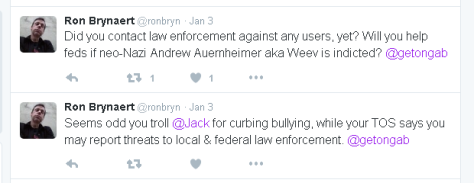
ron-gabtweets

gabsnitch

I don't wish to keep this post longer than it has to be but it's worth mentioning parts of the updated EULA were a result of us. It's humbling that Torba spent the day at his lawyers thinking of us, as he pushed out a new EULA from his nether regions, that still didn't impress Apple enough. Even the greatest eJournalist to ever live, Ron Brynaert, noticed this updated EULA with the "snitch" clause. I'm not going to spoil the rest of it but any users of Gab really do need to read the updated EULA as well as the Privacy Policy.


^ed 

Friday, December 30, 2016

Genes and the Holy G: Siddhartha Mukherjee on the Dark Cultural History of IQ and Why We Can’t Measure Intelligence – Brain Pickings

Genes and the Holy G: Siddhartha Mukherjee on the Dark Cultural History of IQ and Why We Can't Measure Intelligence – Brain Pickings

Genes and the Holy G: Siddhartha Mukherjee on the Dark Cultural History of IQ and Why We Can't Measure Intelligence

"If the history of medical genetics teaches us one lesson, it is to be wary of precisely such slips between biology and culture… Genes cannot tell us how to categorize or comprehend human diversity; environments can, cultures can, geographies can, histories can."

Genes and the Holy G: Siddhartha Mukherjee on the Dark Cultural History of IQ and Why We Can't Measure Intelligence

Intelligence, Simone de Beauvoir argued, is not a ready-made quality "but a way of casting oneself into the world and of disclosing being." Like the rest of De Beauvoir's socially wakeful ideas, this was a courageously countercultural proposition — she lived in the heyday of the IQ craze, which sought to codify into static and measurable components the complex and dynamic mode of being we call "intelligence." Even today, as we contemplate the nebulous future of artificial intelligence, we find ourselves stymied by the same core problem — how are we to synthesize and engineer intelligence if we are unable to even define it in its full dimension?

How the emergence of IQ tests contracted our understanding of intelligence rather than expanding it and what we can do to transcend their perilous cultural legacy is what practicing physician, research scientist, and Pulitzer-winning author Siddhartha Mukherjee explores throughout The Gene: An Intimate History (public library) — a rigorously researched, beautifully written detective story about the genetic components of what we experience as the self, rooted in Mukherjee's own painful family history of mental illness and radiating a larger inquiry into how genetics illuminates the future of our species.

Siddhartha Mukherjee (Photograph: Deborah Feingold)

A crucial agent in our limiting definition of intelligence, which has a dark heritage in nineteenth-century biometrics and eugenics, was the British psychologist and statistician Charles Spearman, who became interested in the strong correlation between an individual's high performance on tests assessing very different mental abilities. He surmised that human intelligence is a function not of specific knowledge but of the individual's ability to manipulate abstract knowledge across a variety of domains. Spearman called this ability "general intelligence," shorthanded g. Mukherjee chronicles the monumental and rather grim impact of this theory on modern society:

By the early twentieth century, g had caught the imagination of the public. First, it captivated early eugenicists. In 1916, the Stanford psychologist Lewis Terman, an avid supporter of the American eugenics movement, created a standardized test to rapidly and quantitatively assess general intelligence, hoping to use the test to select more intelligent humans for eugenic breeding. Recognizing that this measurement varied with age during childhood development, Terman advocated a new metric to quantify age-specific intelligence. If a subject's "mental age" was the same as his or her physical age, their "intelligence quotient," or IQ, was defined as exactly 100. If a subject lagged in mental age compared to physical age, the IQ was less than a hundred; if she was more mentally advanced, she was assigned an IQ above 100.

A numerical measure of intelligence was also particularly suited to the demands of the First and Second World Wars, during which recruits had to be assigned to wartime tasks requiring diverse skills based on rapid, quantitative assessments. When veterans returned to civilian life after the wars, they found their lives dominated by intelligence testing.

Illustration by Emily Hughes from Wild

Because categories, measurements, and labels help us navigate the world and, in Umberto Eco's undying words, "make infinity comprehensible," IQ metrics enchanted the popular imagination with the convenient illusion of neat categorization. Like any fad that offers a shortcut for something difficult to achieve, they spread like wildfire across the societal landscape. Mukherjee writes:

By the early 1940s, such tests had become accepted as an inherent part of American culture. IQ tests were used to rank job applicants, place children in school, and recruit agents for the Secret Service. In the 1950s, Americans commonly listed their IQs on their résumés, submitted the results of a test for a job application, or even chose their spouses based on the test. IQ scores were pinned on the babies who were on display in Better Babies contests (although how IQ was measured in a two-year-old remained mysterious).

These rhetorical and historical shifts in the concept of intelligence are worth noting, for we will return to them in a few paragraphs. General intelligence (g) originated as a statistical correlation between tests given under particular circumstances to particular individuals. It morphed into the notion of "general intelligence" because of a hypothesis concerning the nature of human knowledge acquisition. And it was codified into "IQ" to serve the particular exigencies of war. In a cultural sense, the definition of g was an exquisitely self-reinforcing phenomenon: those who possessed it, anointed as "intelligent" and given the arbitration of the quality, had every incentive in the world to propagate its definition.

With an eye to evolutionary biologist Richard Dawkins's culture-shaping coinage of the word "meme" — "Just as genes propagate themselves in the gene pool by leaping from body to body via sperms or eggs," Dawkins wrote in his 1976 classic The Selfish Gene, "so memes propagate themselves in the meme pool by leaping from brain to brain." — Mukherjee argues that g became a self-propagating unit worthy of being thought of as "selfish g." He writes:

It takes counterculture to counter culture — and it was only inevitable, perhaps, that the sweeping political movements that gripped America in the 1960s and 1970s would shake the notions of general intelligence and IQ by their very roots. As the civil rights movement and feminism highlighted chronic political and social inequalities in America, it became evident that biological and psychological features were not just inborn but likely to be deeply influenced by context and environment. The dogma of a single form of intelligence was also challenged by scientific evidence.

Illustration by Vladimir Radunsky for On a Beam of Light: A Story of Albert Einstein by Jennifer Berne

Along came social scientists like Howard Gardner, whose germinal 1983 Theory of Multiple Intelligences set out to upend the tyranny of "selfish g" by demonstrating that human acumen exists along varied dimensions, subtler and more context-specific, not necessarily correlated with one another — those who score high on logical/mathematical intelligence, for instance, may not score high on bodily/kinesthetic intelligence, and vice versa. Mukherjee considers the layered implications for g and its active agents:

Is g heritable? In a certain sense, yes. In the 1950s, a series of reports suggested a strong genetic component. Of these, twin studies were the most definitive. When identical twins who had been reared together — i.e., with shared genes and shared environments — were tested in the early fifties, psychologists had found a striking degree of concordance in their IQs, with a correlation value of 0.86. In the late eighties, when identical twins who were separated at birth and reared separately were tested, the correlation fell to 0.74 — still a striking number.

But the heritability of a trait, no matter how strong, may be the result of multiple genes, each exerting a relatively minor effect. If that was the case, identical twins would show strong correlations in g, but parents and children would be far less concordant. IQ followed this pattern. The correlation between parents and children living together, for instance, fell to 0.42. With parents and children living apart, the correlation collapsed to 0.22. Whatever the IQ test was measuring, it was a heritable factor, but one also influenced by many genes and possibly strongly modified by environment — part nature and part nurture.

The most logical conclusion from these facts is that while some combination of genes and environments can strongly influence g, this combination will rarely be passed, intact, from parents to their children. Mendel's laws virtually guarantee that the particular permutation of genes will scatter apart in every generation. And environmental interactions are so difficult to capture and predict that they cannot be reproduced over time. Intelligence, in short, is heritable (i.e., influenced by genes), but not easily inheritable (i.e., moved down intact from one generation to the next).

And yet the quest for the mythic holy grail of general intelligence persisted and took us down paths not only questionable but morally abhorrent by our present standards. In the 1980s, scientists conducted numerous studies demonstrating a discrepancy in IQ across the races, with white children scoring higher than their black peers. While the controversial results initially provided rampant fodder for racists, they also provided incentive for scientists to do what scientists must — question the validity of their own methods. In a testament to trailblazing philosopher Susanne Langer's assertion that the way we frame our questions shapes our answers, it soon became clear that these IQ tests weren't measuring the mythic g but, rather, reflected the effects of contextual circumstances like poverty, illness, hunger, and educational opportunity. Mukherjee explains:

It is easy to demonstrate an analogous effect in a lab: If you raise two plant strains — one tall and one short — in undernourished circumstances, then both plants grow short regardless of intrinsic genetic drive. In contrast, when nutrients are no longer limiting, the tall plant grows to its full height. Whether genes or environment — nature or nurture — dominates in influence depends on context. When environments are constraining, they exert a disproportionate influence. When the constraints are removed, genes become ascendant.

[…]

If the history of medical genetics teaches us one lesson, it is to be wary of precisely such slips between biology and culture. Humans, we now know, are largely similar in genetic terms — but with enough variation within us to represent true diversity. Or, perhaps more accurately, we are culturally or biologically inclined to magnify variations, even if they are minor in the larger scheme of the genome. Tests that are explicitly designed to capture variances in abilities will likely capture variances in abilities — and these variations may well track along racial lines. But to call the score in such a test "intelligence," especially when the score is uniquely sensitive to the configuration of the test, is to insult the very quality it sets out to measure.

Genes cannot tell us how to categorize or comprehend human diversity; environments can, cultures can, geographies can, histories can. Our language sputters in its attempt to capture this slip. When a genetic variation is statistically the most common, we call it normal — a word that implies not just superior statistical representation but qualitative or even moral superiority… When the variation is rare, it is termed a mutant — a word that implies not just statistical uncommonness, but qualitative inferiority, or even moral repugnance.

And so it goes, interposing linguistic discrimination on genetic variation, mixing biology and desire.

Illustration by Lisbeth Zwerger for a special edition of the fairy tales of the Brothers Grimm

Intelligence, it turns out, is as integrated and indivisible as what we call identity, which the great Lebanese-born French writer Amin Maalouf likened to an intricate pattern drawn on a tightly stretched drumhead. "Touch just one part of it, just one allegiance," he wrote, "and the whole person will react, the whole drum will sound." Indeed, it is to identity that Mukherjee points as an object of inquiry far apter than intelligence in understanding personhood. In a passage emblematic of the elegance with which he fuses science, cultural history, and lyrical prose, Mukherjee writes:

Like the English novel, or the face, say, the human genome can be lumped or split in a million different ways. But whether to split or lump, to categorize or synthesize, is a choice. When a distinct, heritable biological feature, such as a genetic illness (e.g., sickle-cell anemia), is the ascendant concern, then examining the genome to identify the locus of that feature makes absolute sense. The narrower the definition of the heritable feature or the trait, the more likely we will find a genetic locus for that trait, and the more likely that the trait will segregate within some human subpopulation (Ashkenazi Jews in the case of Tay-Sachs disease, or Afro-Caribbeans for sickle-cell anemia). There's a reason that marathon running, for instance, is becoming a genetic sport: runners from Kenya and Ethiopia, a narrow eastern wedge of one continent, dominate the race not just because of talent and training, but also because the marathon is a narrowly defined test for a certain form of extreme fortitude. Genes that enable this fortitude (e.g., particular combinations of gene variants that produce distinct forms of anatomy, physiology, and metabolism) will be naturally selected.

Conversely, the more we widen the definition of a feature or trait (say, intelligence, or temperament), the less likely that the trait will correlate with single genes — and, by extension, with races, tribes, or subpopulations. Intelligence and temperament are not marathon races: there are no fixed criteria for success, no start or finish lines — and running sideways or backward, might secure victory. The narrowness, or breadth, of the definition of a feature is, in fact, a question of identity — i.e., how we define, categorize, and understand humans (ourselves) in a cultural, social, and political sense. The crucial missing element in our blurred conversation on the definition of race, then, is a conversation on the definition of identity.

Complement this particular portion of the wholly fascinating The Gene with young Barack Obama on identity and the search for a coherent self and Mark Twain on intelligence vs. morality, then revisit Schopenhauer on what makes a genius.


^ed