Friday, February 10, 2017

Americans Renouncing Citizenship at Record High - Bloomberg

Americans Renouncing Citizenship at Record High - Bloomberg
Can I just sell it instead?? 


Americans Renouncing Citizenship at Record High

It all goes back to the Civil War.

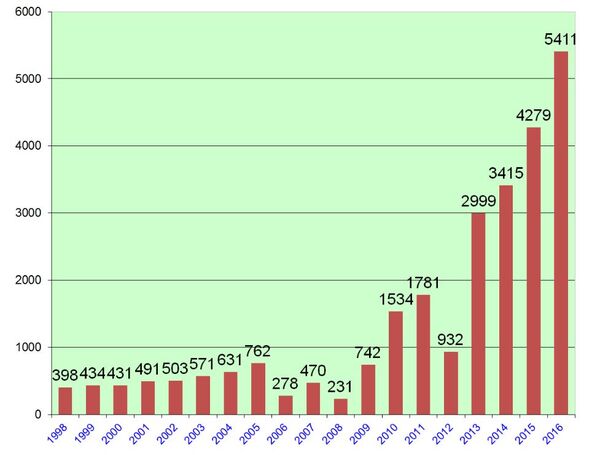
The number of Americans renouncing their citizenship rose to a new record of 5,411 last year, up 26 percent from 2015, according to the latest government data.

Why?

It all goes back to the Civil War, and to a tax meant to deter potential draft dodgers from leaving the U.S. Today, the goal is to make sure that all of the income of U.S. citizens, whether they live and work in the U.S. or not, is reported to the Internal Revenue Service.

The rules got trickier in 2010, when, in an effort to cut down on tax evasion, the Foreign Account Tax Compliance Act (fabulously, Fatca, for short) was passed into law. It basically said foreign institutions holding assets for U.S. citizens had to report the accounts or withhold a 30 percent tax on them if the information wasn't provided. That led some foreign banks to shy away from opening accounts for expats.

Since Fatca came into being, annual totals for Americans renouncing citizenship have reached their four highest historic levels, as shown in the chart below from Andrew Mitchel LLC and its International Tax Blog.

Source: U.S. Treasury Department via Andrew Mitchel LLC

Among the names on the 2016 list of those bidding adieu to the U.S. and its tax code was the U.K.'s foreign secretary, Boris Johnson, who was born in New York. Boldface names from years past (some really past) include the torch song master Josephine Baker, the actor Yul Brynner, the great soprano Maria Callas, businessmen Kenneth and Robert Dart, investor Mark Mobius, and Eduardo Saverin, a co-founder of Facebook. 


^ed 

Bad Trip: Debunking the TSA's 'Behavior Detection' Program | American Civil Liberties Union

Bad Trip: Debunking the TSA's 'Behavior Detection' Program | American Civil Liberties Union

Bad Trip: Debunking the TSA's 'Behavior Detection' Program

Under the government's "behavior detection" program, thousands of TSA officers at airports around the country watch passengers for behaviors that the TSA claims are associated with stress, fear, or deception. The officers then flag certain people for additional inspection and questioning.

The program has long been criticized as unscientific, ineffective, and wasteful, and it has been blamed by passengers and TSA officers themselves for racial and religious profiling – but still it continues.

This report, based on documents the ACLU obtained in a Freedom of Information Act lawsuit, reveals that materials in TSA's own files discredit this junk-science program.

The report's key findings include:

  • The TSA expanded the scope of the behavior detection program and its use of surveillance techniques.
  • Academic research and other documents in the TSA's own files reinforce that behavior detection is unscientific and unreliable.
  • The TSA repeatedly overstated the scientific validity of behavior detection in communications with members of Congress and the Government Accountability Office.
  • Materials in the TSA's files raise further questions about anti-Muslim bias and the origins and focus of the TSA's behavior detection program.
  • The TSA's documents reveal details of specific instances of racial or religious profiling that the TSA concealed from the public.

The report recommends that Congress discontinue funding the TSA's behavior detection program and that the TSA implement a rigorous anti-discrimination training program for its workforce.

About the case

TSA Behavior Detection FOIA Database


^ed 

TSA’s Own Files Show Doubtful Science Behind Its Behavior Screening Program

TSA's Own Files Show Doubtful Science Behind Its Behavior Screening Program

Newly released documents from the Transportation Security Administration appear to confirm the concerns of critics who say that the agency's controversial program that relies on body language, appearance, and particular behaviors to select passengers for extra screening in airports has little basis in science and has led to racial profiling.

Files turned over to the American Civil Liberties Union under the Freedom of Information Act include a range of studies that undermines the program's premise, demonstrating that attempts to look for physical signs of deception are highly subjective and unreliable. Also among the files are presentations and reports from the TSA and other law enforcement agencies that put forth untested theories of how to profile attackers and rely on broad stereotypes about Muslims.

The TSA has deployed behavior detection officers, or BDOs, at security checkpoints and in plainclothes throughout airports to look for travelers exhibiting behaviors that might betray fear, stress, or deception. According to the documents, these officers engage in "casual conversations" such that the passengers don't realize they "have undergone any deliberate line of questioning."

These spotters can pick people out for extra screening, refer them to law enforcement or immigration authorities, or block them from boarding a plane.

Looking out for suspicious behaviors is hardly surprising, but TSA's approach has been roundly criticized by government watchdogs and outside observers who say there's no scientific basis for the clues the officers rely on as indicators. The program — previously known as "SPOT," for Screening Passengers by Observation Techniques, and now called "Behavior Detection and Analysis" — has cost $1.5 billion since it was rolled out in 2007, according to a recent inspector general's report.

In 2015, The Intercept published the TSA's checklist for behavior detection officers, which included dozens of apparently suspicious indicators, such as "excessive fidgeting," "strong body odor," "whistling," and "exaggerated emotions." Many of the behaviors on the list contradicted one another, and most seemed like they could apply to any number of travelers going through a security screening and heading to a flight. A former officer in the program told The Intercept at the time that the list was "just 'catch all' behaviors to justify BDO interaction with a passenger. A license to harass."

In an emailed statement, TSA spokesperson Bruce Anderson said that "TSA stands by its Behavior Detection capability." The TSA's approach, he said, "is threat-agnostic, and unlike technology, does not become obsolete when the adversary develops a new weapon or tactic. It is one element of TSA's efforts to mitigate threats against the traveling public, and is critical to TSA's systems approach to deter, detect, and disrupt individuals who pose a threat to aviation." He pointed to a TSA report asserting that the agency has relied on "sound and substantial" outside research as well as its own studies to refine and revise the list of indicators. 

Anderson also said that the TSA no longer considered behavior detection a unique program and had incorporated behavior detection officers into the regular workforce.

The TSA has previously been accused of racial profiling in picking out passengers for extra screening. The documents obtained by the ACLU reveal additional details of incidents at airports where the TSA was prompted to investigate. In Newark, for example, a TSA investigation found that officers had been directed to focus on particular nationalities and "to pull Latin American and Arabic looking passengers." In Chicago, an officer alleged that BDOs were told to "pay particular attention" to passengers flying on Middle Eastern airlines, who were likely to carry large amounts of money and have outstanding warrants.

"In these investigations, it becomes very clear how the indicators can be used for wrongful profiling, how they give them a basis for action against someone they don't like the look of," said Hugh Handeyside, an attorney at the ACLU's National Security Project. "They underscore that these indicators are subjective and can be arbitrarily applied."

In an internal survey, one behavior detection officer left an anonymous complaint stating that the officer had seen coworkers "make questionable decisions based on the way someone looks I.e. cute, Asian, Black, etc."

"They are quick to ask 'Was he Somali or Egyptian?' when speaking about an airport employee who comes into question: as if these are the only races out to cause harm," the comment continues. "What's worse is I've heard a BDO officer refer to passengers as 'towel heads' when speaking in a meeting with other management AND his subordinates. When I reported it, I was told that was to be expected of him."

The TSA maintains that many of these instances were unsubstantiated, and that the agency added training and modified certain procedures to address concerns about profiling.

In requesting the documents, the ACLU asked to see any scientific research behind the behavior detection programs. It appears there was none, beyond previously published articles of questionable relevance to the TSA program.

"We got back a ton of academic literature and press articles that don't provide a scientific basis for the program, and materials from other parts of the government that don't provide any kind of credibility because they simply aren't appropriate for airport screening, such as military studies from war zones," Handeyside said. "The TSA simply has nothing in its files that would suggest that it can validly use these techniques to screen passengers in an unstructured environment like an airport terminal."

Some of the materials the TSA turned over rely on problematic assumptions. One TSA presentation from 2006, titled "Femme Fatale: Female Suicide Bombers," says that "females tend to be more emotional and therefore easier to indoctrinate."

Other materials show generic characterizations of Muslims as prone to radicalization.

It's not clear whether the agency used these particular documents to train behavior detection officers, but in a 2012 memorandum, the head of the TSA at the time admitted that the training materials for behavior detection officers had a "current exclusive focus on examples on Arab/Muslim terrorists."

The TSA denied that its policies rely on religion as a factor.

Top photo: A passenger undergoes a full-body scan at El Paso International Airport in Texas in 2010.


^ed 

Niemöller, "First they came for the Communists..."

Sanity for Superheroes: Niemöller, origin of quotation "First they came for the Communists..."

Niemöller, origin of quotation "First they came for the Communists..."

In November 1945 German Pastor Martin Niemöller visited the former Dachau concentration camp, where he had been imprisoned from 1941 to April 1945. His diary entry about that visit and some subsequent speeches he gave imply that that visit triggered the thought that became this famous quotation. Since discovering the diary entry in the late 1980s I've tried to find out when Niemöller first said that quotation in its poetic form, but I have not been able to document it with a published source. Thus I can't say what the original version was. However, the quotation most likely emerged in 1946, and it definitely took on the well-known poetic form by the early 1950s.

  • I began the research for this page by obtaining published speeches Niemöller gave in the period 1945-1954, and searching in them for this or similar statements (jump to discussion, below). Below (and on separate pages) readers will find passages from these published speeches, with English translations, and some interpretative discussion, including a list of other sources I obtain and examine as time permits.
  • I have also examined other researchers' discussions of the origins of this quotation (jump to section, below).
  • Finally, I have a section with other versions of the quotation I found on the web (jump to section).
  • As usual with websites, this page is continually being expanded, and I welcome your comments mailto: marcuse@history.ucsb.edu>.

News and announcements (back to top)
  • Feb. 24, 2012:
  • Jan. 26, 2012: Florida governor Rick Scott, speaking to the Board of a state business group, used his own interpretation of Niemöller's quotation to defend Mitt Romney. He began by saying that he had a poster of the quotation on his walls (beginning with "... the Jews ..."), then said other Republican candidates shouldn't attack Bain Capital.
    • Miami Herald blog post; Local channel 10 news blurb;
    • One of the responses to the Herald blog post was this adaptation:
      First Rick Scott came for the teachers, but I said nothing as my kids were nearly out of school.
      Then he came for the university professors, but my kids don't take anthropology so I said nothing.
      Then he came for the prisons and handed those over to corporations. And still I said nothing because I hadn't broken any laws.
      "Then he came for the writers and thinkers and the political activists, and I thought, serves those people right for being so mouthy.
      Then he came for our county commissions, our school boards, he wanted it all. And since I had said nothing all through this, there was no one left to help me.
      Now I am in corporate jail raising tilapia in a fish pond for 25 cents a day."
  • 4/22/11 (updated 9/12/11): I added 13 pages scanned from a 1986 German book composed of 15 biographical interviews upon which a film about his life was based. In one interview Niemöller talks in 1976 about a 1974 event in which he resurrected the quotation. The book is titled Was würde Jesus sagen? -- What would Jesus say?
    • Note that the book is in German. The German Niemöller Foundation uses this passage (Niem. Found. quotation page), in which Niemöller refers to what the Niemöller Foundation dates as a 1976 event, to call this the "classical" version. However in this 1976 interview Niemöller no longer remembered the version he had used in the late 1940s. When he gave the interview in the 1976 he was 84 years old (born in 1892), so it is understandable that he might better remember something he said a few years earlier than an even earlier use 30 years before that..
    • Note further that the separately printed version on p. 71 of that book does not include the Jews (!), as if Niemöller himself had not mentioned them. However, since the interview question was about Jews, the fact that N. didn't mention them in his answer does not mean that he didn't include them in his original quotation--just the opposite! This adds another point of confusion to the already murky lineage of the quotation.
    • Finally, I've included extra pages in the pdf, namely the prefaces, the table of contents, and a timeline of Niemöller's life (final pages). I added asteriks in the margin to indicate where, in his answer, he mentions the Communists, Trade Unions, and Social Democrats, in that order (see p. 69).
  • 12/13/10: A video version of the quotation is embedded on silentconscience.org, Dec. 2, 2010; originally by karmic courage on youtube (5:20), uploaded Feb. 15, 2008 [14,488 views on 12/12/2010].
  • 5/20/10: Another flagrant misappropriation of the quotation (see 12/16/09 announcement, below), this time by Glenn Beck, as shown on the 5/13/20 Daily Show (salon.com page "Lewis Black tells Glenn Beck a thing or two about Nazism" with embedded youtube clip; the references come at 4:30 and 5:15 into the clip):
    • "You ever heard of the old poem 'first they came for the Jews'? Well, first they came for the banks, then it was the insurance companies, then it was the car companies." (Black: difference "they came for the Jews to kill them, but to the companies give the $700 billion.)
    • Beck: "First they came for the Jews and I stayed silent----next I'll show you the very latest attacks on me ..."
    • Update 4/22/11: See also this 10/14/2009 mediate.com article "Glenn Beck compares Fox News to the Persecution of the Jews"
  • 5/2/10: I received an inquiry about how to teach this quotation in a high school class:
    • I am a teacher for the City of Boston, high school special education; I taught a unit on the Holocaust, and will introduce the famous passage, First they came, and have my students analyze this quote.
      I am in need of your help as I wish to teach my students how to effectively analyze this quote. Any suggestions?
    • Here is what I answered:
      As a historian at the college level, I'd probably say have students compare the original texts on my website with the "poem" version. Especially for a special ed class it might be of interest that in the earliest versions Niemöller definitely included the disabled (which is historically correct and logical), but none of the later poem versions do.
      Since this may be too advanced for high school, here is a site with a lesson plan for high school that I think is very good: 6-page lesson plan "Exploring Personal and Collective Responsibility in WWII" by the National D-Day Museum in New Orleans.
      I'd give the students a little more biography of Niemoeller than that site offers. An excellent primary source is this Feb. 1938 Time magazine article that talks about what he did in WWI and how close he had been to the Nazis at the outset, and how he got into trouble with them.
      In addition, if I recall correctly, Niemöller later often told an anecdote about how his sub sank a ship off Greece, and although international law required the rescue of drowning passengers, he did not do that, which later came back to haunt his conscience.
  • 3/05: I've added a translation of the Stuttgart Declaration of Guilt (Stuttgarter Schuldbekenntnis)
  • 1/29/07: Another quotation of mysterious origin: "One man with courage makes a majority"--is often attributed to US president Andrew Jackson, but he never said it. In fact, it was penned by an 1860 biographer who was critical of Jackson. See Daniel Feller, "The greatest thing Andrew Jackson never said," LA Times, Jan. 26, 2007. (hi-res printable scan)
  • 2/13/07: rendition of the Niemöller quotation published in 1955 by Milton Mayer added. The quotation was clearly circulating before 1951, when Mayer conducted that interview. The importance of this publication is that it sets a so-called terminus ante quem--a date before which Niemöller must have said whatever version(s) he used.
  • 10/29/07: Images of Quotation page added.
  • 8/19/08: Discussion of false attribution to Bertolt Brecht added, below.
    YouTube clips:
    • 1:11 by nyprogressive, added 9/27/06; text montage a la Star Wars; 1946: Communists, Socialists, trade unionists, me; 2006: foreigners
    • 2:07 by Michelle Malkin, added 12/31/06; montage of news photos; about violence after Danish Mohammed cartoons
    • 5:30 by Kate Chaplin, added 2/15/08; recited by a professional with a gas-guzzling Hummer: Jews, gays, Muslims, me.
  • 12/16/09: a reader of this page sent me a link to Jon Stewart's persiflage of one of the Republican speakers' bowdlerization of the quote at a recent "tea party" in Washington D.C. Fox News star and talk radio host Laura Ingraham said (roughly) the following (note: this was not very articulate, although she appears to be reading from a script):
    First they came for the rich, and I did not speak out because I was not rich,
    Then they confiscated the property owners,
    Then they took away our right to bear arms, but I didn't speak out because I wasn't armed.

    (This segment starts about 3 mins. into the full episode, but do watch from the beginning.)


^ed 

Examining the Establishment Clause in Public Educational Policy and Finance © 2017

In God We Trust: Applying the Lemon Test for Public Funds for Parochial Schools by Elyssa D. Durant, Ed.M. | DailyDDoSe © 2016

In God We Trust: Do Public Funds for Parochial Schools Violate the Establishment Clause? 


Elyssa D. Durant, Ed.M.

In God We Trust: Applying the Lemon Test for Public Funds for Parochial Schools by Elyssa D. Durant, Ed.M.

In God We Trust: Examining the Establishment Clause and Public Funds in Educational Policy and Finance 

by Elyssa D. Durant, Ed.M. © 2017

1. How can school vouchers reach a balance between serving the public interest and preserving individual freedoms and rights?
2. What additional arguments can be presented for against the use of school vouchers for parochial schools?
3. How is the issue of school vouchers for sectarian institutions different or similar from issues surrounding prayer in school?
4. What are the common issues relevant to both charter schools and voucher programs?

This article will address concerns regarding the long-term outcomes of school choice and voucher programs. Specifically: do school vouchers exacerbate the inequality between the rich and the poor?

Since I believe that health care and education are both social goods, I have some reservations about letting the free-market run amok during such a critical point in history. Is it wise to allow for-profit market forces to dictate public goods when natural rights are at stake?

The shortcomings of the Medicaid managed care programs, Medicare supplemental insurance policies, and demonstration projects such as the privatization of prisons provide sufficient evidence of the dangers of profit driven corporations in American culture. Corporate scandals with food and other suppliers contracted by the Board of Education in New York City in the late 1990's provide excellent examples of how easy it is for private companies to manipulate funds away from the target recipients.

It was not too long ago that private managed care companies offered gifts to boost enrollment by enticing desperate Medicaid recipients to join their plans. This marketing strategy is simply offensive when we are dealing with a social good albeit health care or education. Vulnerable populations are frequently exploited through corporate contracts and there is little reason to believe that for-profit conglomerates would treat public schools or economically disadvantaged students and families otherwise.

Arguments on both sides of the school voucher issue are very similar to those presented for and against charter schools and free-market school choice. Smrekar (1998) presents four key issues that have been at the center of the school choice debate: (1) economic, (2) political; (3) social justice; and (4) pedagogical.

The economic argument in favor of school choice points out that our current public education system resembles a monopoly. Proponents argue that the introduction of choice into the educational marketplace will promote competition and force schools with poor performance records to improve or close (Friedman, 1968).

The political argument is centered on the democratic ideal that the freedom to choose where your child attends school is a fundamental right. The political argument also triggers strong feelings about the role of education in a democratic society. There are those who feel that the public school is intended, at least in part, to create a common set of core values that is best served by the public sector.

At the core of the political school choice argument is a debate regarding the benefits of providing a common set of experiences in a democracy versus promoting individual choice and liberty (Smrekar, 1998). This issue, while not dead, was challenged in 1925 when the Supreme Court ruled in Pierce v. Society of Sisters (268 U.S. 510 (1925)) in favor of parents who sent their children to private school. This argument continues today and is at the center of both school choice and curriculum debates.

The social justice argument is a bit more complicated and there is little agreement on any front. Proponents argue that school choice empowers the poor to participate in the education of their children by giving them the same options available to wealthier families in the United States. According to a 1997 poll in USA Today, 47% of parents would send their children to private schools if they had the financial resources (Doyle, 1997).

Information is an essential component to any school choice program. In order to ensure social equity in school choice programs we need to be sure that the "poor" are fully informed of their choices and are not taken advantage of in the open market. Research has shown that the act of "choosing" has positive effects on the school environment and promotes parental involvement in their children's education (Doyle, 1997). Additional components of the social justice argument have focused on the nuts and bolts of choice programs, and point out how there are several different ways that choice programs may (wittingly or unwittingly) promote social inequity (Cookson, 1995). Such arguments focus on transportation problems, admissions policies, the availability of information, and how we define "choice" and implement policies regulating recruitment, enrollment and performance of participating schools, (Cookson, 1995; 1997).

The pedagogical argument points out that school choice programs are better suited for the individual needs inherent to a pluralistic society. Although some feel there is value in providing core curriculum and a common set of basic skills, there is a current trend towards specialty schools that focus on the arts and sciences, technology, vocational training, etc. Educators look towards successful magnet schools as examples of the pedagogical success that demonstrated the importance of school choice and parental involvement as indicators of educational outcomes. Some educators fear that the introduction of school choice and voucher plans would prompt the best students to leave public schools and that this would have a negative effect on the overall climate of public classrooms.

Among the various school voucher programs, there is considerable controversy surrounding the program design that gives qualified individuals the choice to attend parochial schools using public funds. Traditional arguments against this type of school voucher program have focused on the constitutionality of using state funds for sectarian institutions. In theory, public schools are believed to be completely independent of religious institutions and provide a place where young adults can join together and develop a core set of "American" values and "democratic" principles. Just this year, states such as Tennessee have modified the curriculum to include Bible class in publicly funded classrooms. It is not yet known how this will be implemented given the number of students who did not meet the No Child Left Behind (NCLB) benchmarks. They are just now trying designing the course content and have not yet selecting the text to be used next fall (2008).

Historically, the church had a key role in the education of children in America. During the National Period (1780-1830), churches were used to educate children, and the King James Bible was used as a reader in these classrooms (Smrekar, 1998). Derek Neal (1997) points out that much of the current sentiment against Catholic schools is not a reflection of their excellent performance record, but rather an indication of the anti-Catholic sentiment which swept the country during the late part of the 19th Century (Neal, 1997). Neal argues that until that point, there was no contest to religious education as long as it was Protestant.

Catholic schools have traditionally served the children of the working class. They were a major socializing force earlier in the century and continue to succeed with children who might otherwise fall through the cracks in public schools. Despite tapering enrollment, Catholic schools remain a viable force in the private sector providing a reasonably priced private education to American children. Neal conducted a study that looked at the graduation rates of minority children attending Catholic schools compared with children attending public schools in the inner cities. Controlling for demographic variables, (parent's education, parent's occupation, family structure, and reading materials at home) closer analysis revealed graduation rates for urban minorities are 26% higher in Catholic schools compared with public schools in the same communities. Although Neal found similar benefits for whites and in suburban communities, this effect was most profound for urban minorities.

Other studies have focused on identifying the qualities that make Catholic schools successful. A number of factors have been identified by Bryk and Lee, including active parental participation and the benefits of school choice in creating an inclusive community that fosters a common set of values and ideals (Bryk & Lee, 1995). Interestingly, the very same variables found to enhance the performance of Catholic school students are remarkably similar to the reported benefits of magnet schools and choice programs. Despite the excellent performance records of Catholic schools, there are currently no voucher programs that allow parochial schools to participate in state funded voucher programs.

The reason for this is quite simple, but not necessarily correct or in the best interest of our children. The Establishment Clause of the First Amendment of the United States Constitution prohibits the use of public funds in religious institutions. However, it can also be argued that it is unconstitutional to exclude parochial schools from voucher systems because it violates the student's free expression of religion. In addition, voucher programs require a conscious decision on the part of the student and the parent. The state does not enforce a blanket endorsement of any one religion. I use Catholic schools as an example because they represent the majority of parochial schools in urban America.
Voucher programs typically undergo strict scrutiny for all four reasons mentioned above, but this issue is especially true of any choice or voucher program that channels funds into Parochial schools. For this reason, Catholic schools and other schools with religious affiliations have been excluded from voucher plans up until this point. It is not politically viable to institute a choice or voucher program at any level (at the district, state or national level) since similar plans have historically presented long-standing, hard-fought, legal challenges to the Establishment Clause of the First Amendment of the United States Constitution.

Since the Supreme Court has not ruled on this issue, most challenges up until this point have taken place in state courts[1]. These state decisions have been split, and while there are a few voucher programs operating in Wisconsin and Ohio, neither permits sectarian schools to participate in their programs. Milwaukee designed a voucher system that included parochial schools in 1995 but later revised their proposal after the Wisconsin Supreme Court issued a temporary injunction against expansion into religious schools (Kremerer & King, 1995).

School choice programs that involve vouchers have not been tested in the Supreme Court, but there is a long history of court cases that challenge the flow of money from the public sector into private, sectarian institutions. The recent pattern of Supreme Court rulings has lead some legal scholars (Kremerer & King, 1995) to conclude that school vouchers would pass constitutional muster under the following circumstances:

1. Provides payments in the form of scholarships to parents of school age children
2. Allows parents to choose among a variety of public and private sectarian and nonsectarian schools for their children
3. Gives no preference to sectarian private institutions
Voucher programs up until this point have encountered substantial resistance from the legal community and a number of civil rights and political organizations. This becomes more pronounced when the voucher model includes sectarian institutions in the model plan and state court rulings have been inconsistent in decisions surrounding the constitutionality of voucher programs.

The definitive case regarding school voucher programs is Lemon v. Kurtzman (403 U.S. 602 (1971)). The Court's ruling in Lemon was based on three components that came to be known as the "Lemon Test." The Lemon Test applies the following to any Constitutional challenge of the Establishment Clause:
1. The government action must have a secular purpose
2. The primary effect must neither advance, nor inhibit religion
3. It must not result in excessive governmental entanglement with religion

Since voucher programs do not generally provide support directly to the institution, individual freedom and choice remain intact. Individual families are empowered by educational vouchers since they choose the school and religion appropriate for them. Qualified schools are not determined by religious affiliation and all schools are required to adhere to state and federal regulations that increase accountability. Similar issues came before the courts in Pierce v. Society of Sisters (268 U.S. 510 (1925)) as well, however Lemon v. Kurtzman (403 U.S. 602 (1971)) is considered to be both the landmark and test case currently before the courts.

The reason for this is quite simple, but not necessarily correct or in the best interest of our children. The Establishment Clause of the First Amendment of the United States Constitution prohibits the use of public funds in religious institutions. However, it could also be argued that it is unconstitutional to exclude parochial schools from voucher systems because it violates the free expression of religion. In addition, voucher programs require a conscious decision on the part of the student and the parent. The state does not enforce a blanket endorsement of any one religion. I use Catholic schools as an example because they represent the majority of parochial schools in urban America.

Teacher's unions are resistant to bring in a new system that has the potential to upset their job status and security. It will likely be a number of years before we truly understand the effects of magnet schools and can evaluate the implementation of school choice programs that are already in place. Because we are dealing with such an essential human, social good, it is my recommendation that we do not implement a largest-scale voucher program until issues of access and equity are resolved on other public fronts. We must ensure real choices for the students and families who are not information savvy and may be limited in their ability to recognize the real value of their options. We must find a way to ensure the equitable distribution of resources so that education truly does will empower the poor.
Is it time to apply the Lemon Test to school vouchers?
You decide.

References
Cookson, P.W., Jr. (1994). School choice: The struggle for the soul of American education. New Haven: Yale University Press.

Cookson, P.W., Jr. (1995). ERIC Digests: School Choice.

Doyle, D.P. (1997). Vouchers for religious schools. Public Interest, 127, 88-95.

Haynes, C.C. (1993). Beyond the culture wars. Educational Leadership, 51(4), 30-34.

Houston, P.D. (1993). School vouchers: The latest California joke. Phi Delta Kappan, 75(4), 61-64.

Kremerer, F.R. & King, K.L. (1995). Are school vouchers Constitutional? Phi Delta Kappan, 77(1), 307-311.
Kremerer, F.R. (1995). The Constitutionality of school vouchers. West's Education Law Reporter,101 Ed. Law Rep. 17.

Kremerer, F.R. (1997). State Constitutions and school vouchers. West's Education Law Reporter, 120 Ed. Law Rep. 1.

Neal, D. (1997). Measuring Catholic school performance. Public Interest, 127, 81-87.

[1] Including a decision that was handed down regarding a choice plan in Ohio. (12/18/2000)

Elyssa D. Durant © DailyDDoSe 1996-2016


^ed