Wednesday, January 9, 2019

U.S. Department of Labor -- Personnel Accountability Status

U.S. Department of Labor -- Personnel Accountability Status
Trump must be held accountable for Hawaii, Russia, Emergency Alert to cell phones and the shit show last night. 


Emergency Accountability Status Link (EASL)

This website is intended for DOL employees and contractors and should only be utilized as a redundant notification method for reporting their initial accountability status in the event of an emergency (natural or man-made).

This redundant accountability tool is meant to be used when primary means of communications (phone or email) to directly contact your supervisor have failed or are unavailable. This website is not intended for use by DOL employees for reporting their inability to report to work in the case of personal/family emergencies.

Please do not use this form to test the system. If you would like to try the information submission process now, please use the test form.

GO TO THE TEST FORM

WARNING

you are about to access a U.S. Government computer/information system. Access to this system is restricted to authorized users only. Unauthorized access, use, or modification of this computer system or of the data contained herein, or in transit to/from this system, may constitute a violation of Title 18, United States Code, Section 1030 and other federal or state criminal and civil laws. These systems and equipment are subject to monitoring to ensure proper performance of applicable security features or procedures. Such monitoring may result in the acquisition, recording and analysis of all data being communicated, transmitted, processed or stored in this system by a user.

If monitoring reveals possible misuse or criminal activity, notice of such may be provided to supervisory personnel and law enforcement officials as evidence.

Anyone who accesses a Federal computer system without authorization or exceeds their access authority, and by any means of such conduct obtains, alters, damages, destroys, or discloses information, or prevents authorized use of information on the computer, may be subject to fine or imprisonment, or both.

I understand that I am personally responsible for my use and any misuse of my access including my system account and password. I understand that by accessing a U.S. Government information system that I must comply with the prescribed policies and procedures. I acknowledge receipt of, understand my responsibilities, and will comply with the rules of behavior for this system.

* = Required Information

If you don't know your OASAM region, view this map of OASAM regions.

Go to an alternate version of the accountability status form.


Policy & Research Analyst


Elyssa D. Durant
Policy & Research Analyst

Classless inter-domain routing (CIDR) and Notation for Beginners

Classless inter-domain routing (CIDR) and Notation for Beginners

What is my IP address? 

BLACKLISTED 


WHO IS MY ADMIN?


What Is CIDR Notation?
Classless inter-domain routing (CIDR) and Notation for Beginners

Classless inter-domain routing (CIDR) is a set of Internet protocol (IP) standards that is used to create unique identifiers for networks and individual devices. The IP addresses allow particular information packets to be sent to specific computers. Shortly after the introduction of CIDR, technicians found it difficult to track and label IP addresses, so a notation system was developed to make the process more efficient and standardized. That system is known as CIDR notation.

CIDR IP addresses consist of two groups of numbers, which are also referred to as groups of bits. The most important of these groups is the network address, and it is used to identify a network or a sub-network (subnet). The lesser of the bit groups is the host identifier. The host identifier is used to determine which host or device on the network should receive incoming information packets. In contrast to classful routing, which categorizes addresses into one of three blocks, CIDR allows for blocks of IP addresses to be allocated to Internet service providers. The blocks are then split up and assigned to the provider's customers. Until recently, IP addresses used the IPv4 CIDR standard, but because IPv4 addresses are nearly exhausted, a new standard known as IPv6 has been developed and will soon be implemented.

Development of CIDR

When the Internet domain name system (DNS) was first established, the classful routing system was used for IP addresses, but early Internet developers soon discovered that it included a serious flaw in that it lacked scalability. To solve this problem, the Internet Engineering Task Force created the IPv4 standard in 1993. In addition, CIDR was created as a system of routing the new IPv4 addresses. These standards were originally published under the names RFC 1518 and RFC 1519. In 2006, a new version of the standard was published as RFC 4632.

According to the CIDR standard, the first part of an IP address is a prefix, which identifies the network. The prefix is followed by the host identifier so that information packets can be sent to particular computers within the network. With the classful routing system, individual networks were either limited to 256 host identifiers or overburdened with 65,536 identifiers. For many network enterprises, 256 identifiers were not enough and 65,536 were too burdensome to be used efficiently.

In the 1980s, as TCP/IP grew into the modern Internet, the need for a more flexible routing system was recognized. This need prompted the development of CIDR and subnets. CIDR and the process of variable-length subnet masking (VLSM) allow network administrators to divide individual networks into subnets of various sizes. In addition, addresses for related operations can be grouped together to create a simple system of categorization. Internet providers are also able to allocate a scalable number of addresses, in blocks, to organizations based on how many addresses are needed.

These new routing and categorization systems solved most of the problems with IP addresses, and the only remaining problem was deciding how to identify them efficiently. Eventually, CIDR notation was established and accepted as the standard. In CIDR notation, IP addresses are written as a prefix, and a suffix is attached to indicate how many bits are in the entire address. The suffix is set apart from the prefix with a slash mark. For instance, in the CIDR notation 192.0.1.0/24, the prefix is 192.0.1.0, and the total number of bits in the address is 24.

CIDR Blocks

The ability to group blocks of addresses into a single routing network is the hallmark of CIDR, and the prefix standard used for interpreting IP addresses makes this possible. CIDR blocks share the first part of the bit sequence that comprises the binary representation of the IP address, and blocks are identified using the same decimal-dot CIDR notation system that is used for IPv4 addresses. For example, 10.10.1.16/32 is an address prefix with 32 bits, which is the highest number of bits allowed in IPv4. Addresses with identical prefixes and the same number of bits always belong to the same block. In addition, larger blocks can be easily distinguished from smaller blocks by the length of the prefix. Short prefixes allow for more addresses while large prefixes identify small blocks.

CIDR notation is also used for the newer IPv6 standard, and the syntax is the same. The only difference is that IPv6 addresses may contain up to 128 bits instead of the 32-bit maximum of IPv4. Even though IPv6 addresses may be up to 128 bits in length, it is important to note that subnets on MAC layer networks always use 64-bit host identifiers.

The assignment of CIDR blocks is handled by the Internet Assigned Numbers Authority (IANA). One of the duties of the IANA is to issue large blocks of IP addresses to regional Internet registries (RIRs). These blocks are used for large geographical areas, such as Europe, North America, Africa and Australia. It is then the duty of each RIR to create smaller, but still quite large, blocks of IP addresses to be assigned to local Internet registries (LIRs). Depending on the organization of regional and local registries, blocks may be subdivided further until they are assigned to end users. The size of blocks assigned to end users is dependent on how many individual addresses will be required by each user. Most end users receive their blocks from a single Internet service provider (ISP), but organizations that make use of multiple ISPs must obtain provider-independent blocks directly from an LIR or RIR.

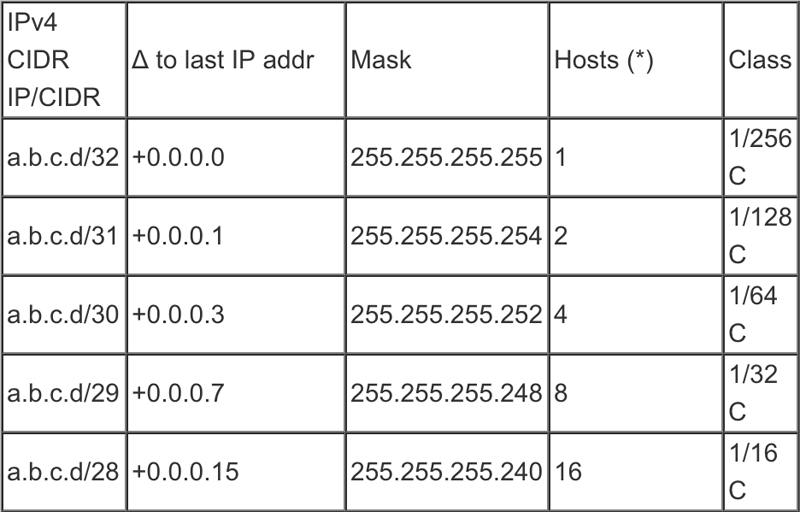
IPv4 CIDR IP/CIDRΔ to last IP addrMaskHosts (*)Class
a.b.c.d/32+0.0.0.0255.255.255.25511/256 C
a.b.c.d/31+0.0.0.1255.255.255.25421/128 C
a.b.c.d/30+0.0.0.3255.255.255.25241/64 C
a.b.c.d/29+0.0.0.7255.255.255.24881/32 C
a.b.c.d/28+0.0.0.15255.255.255.240161/16 C
a.b.c.d/27+0.0.0.31255.255.255.224321/8 C
a.b.c.d/26+0.0.0.63255.255.255.192641/4 C
a.b.c.d/25+0.0.0.127255.255.255.1281281/2 C
a.b.c.0/24+0.0.0.255255.255.255.0002561 C
a.b.c.0/23+0.0.1.255255.255.254.0005122 C
a.b.c.0/22+0.0.3.255255.255.252.0001,0244 C
a.b.c.0/21+0.0.7.255255.255.248.0012,0488 C
a.b.c.0/20+0.0.15.255255.255.240.0004,09616 C
a.b.c.0/19+0.0.31.255255.255.224.0008,19232 C
a.b.c.0/18+0.0.63.255255.255.192.00016,38464 C
a.b.c.0/17+0.0.127.255255.255.128.00032,768128 C
a.b.0.0/16+0.0.255.255255.255.000.00065,536256 C = 1 B
a.b.0.0/15+0.1.255.255255.254.000.000131,0722 B
a.b.0.0/14+0.3.255.255255.252.000.000262,1444 B
a.b.0.0/13+0.7.255.255255.248.000.000524,2888 B
a.b.0.0/12+0.15.255.255255.240.000.0001,048,57616 B
a.b.0.0/11+0.31.255.255255.224.000.0002,097,15232 B
a.b.0.0/10+0.63.255.255255.192.000.0004,194,30464 B
a.b.0.0/9+0.127.255.255255.128.000.0008,388,608128 B
a.0.0.0/8+0.255.255.255255.000.000.00016,777,216256 B = 1 A
a.0.0.0/7+1.255.255.255254.000.000.00033,554,4322 A
a.0.0.0/6+3.255.255.255252.000.000.00067,108,8644 A
a.0.0.0/5+7.255.255.255248.000.000.000134,217,7288 A
a.0.0.0/4+15.255.255.255240.000.000.000268,435,45616 A
a.0.0.0/3+31.255.255.255224.000.000.000536,870,91232 A
a.0.0.0/2+63.255.255.255192.000.000.0001,073,741,82464 A
a.0.0.0/1+127.255.255.255128.000.000.0002,147,483,648128 A
0.0.0.0/0+255.255.255.255000.000.000.0004,294,967,296256 A

* For routed subnets bigger than /31 or /32, two reserved addresses need to be subtracted from the number of available host addresses: the largest address, which is used as the broadcast address, and the smallest address, which is used to identify the network itself. In addition, any border router of a subnet typically uses a dedicated address.

Subnet Masks

Once blocks of IP addresses are assigned to end users, CIDR allows them to be further divided within a private network, which is a process known as subnetting. Computers and other connected devices within a particular subnet can be identified because they all use the same IP address prefix. The subnet identifier then becomes the most significant portion of the host identifier. Finally, the last part of the host identifier is used to distinguish individual computers on a subnet.

The subnet identifiers within a network are assigned according to the network's subnet mask, which is a binary pattern that is used to determine how many subnets are available in a network. In its binary form, a subnet mask begins with a series of ones and ends with a series of zeros. However, subnet masks are usually expressed using the familiar dot-decimal notation used for IP addresses and network prefixes. In this notation, the series of ones become the number 255. For example, the most common subnet mask expressed using this notation is 255.255.255.0. This subnet mask is known as subnet zero, and it is used when only one subnet is required or as the first of multiple subnets.

A specific subnet mask is created by designating a portion of the host identifier, and larger subnets are created by moving more bits from the host identifier to the subnet mask. The final subnet of a network is designated in binary with all ones. When using the CIDR dot-decimal notation, the final subnet is expressed as 255.255.255.255.

Before CIDR, subnet masks with all zeros (255.255.255.0) and subnet masks with all ones (255.255.255.255) could not be used because they could become confused with network identifiers, but CIDR-compliant equipment uses the prefixes and suffixes of CIDR notation to distinguish between the two.

Related Articles


Elyssa D. Durant 
Research & Policy Analyst
Columbia University, New York

Litigious Liberal: How do I file a complaint with the AG when we don’t have one?

Section 508 of the Rehabilitation Act | Federal Communications Commission

Section 508 of the Rehabilitation Act

Section 508 of the Rehabilitation Act - 29 U.S.C. § 798

SECTION 508 - ELECTRONIC AND INFORMATION TECHNOLOGY

(a) Requirements for Federal Departments and Agencies:

(1) Accessibility:

(A) Development, procurement, maintenance, or use of electronic and information technology: When developing, procuring, maintaining, or using electronic and information technology, each Federal department or agency, including the United States Postal Service, shall ensure, unless an undue burden would be imposed on the department or agency, that the electronic and information technology allows, regardless of the type of medium of the technology—
(i) individuals with disabilities who are Federal employees to have access to and use of information and data that is comparable to the access to and use of the information and data by Federal employees who are not individuals with disabilities; and
(ii) individuals with disabilities who are members of the public seeking information or services from a Federal department or agency to have access to and use of information and data that is comparable to the access to and use of the information and data by such members of the public who are not individuals with disabilities.
(B) Alternative means efforts: When development, procurement, maintenance, or use of electronic and information technology that meets the standards published by the Access Board under paragraph (2) would impose an undue burden, the Federal department or agency shall provide individuals with disabilities covered by paragraph (1) with the information and data involved by an alternative means of access that allows the individual to use the information and data.

(2) Electronic and information technology standards:

(A) In general: Not later than 18 months after the date of enactment of the Rehabilitation Act Amendments of 1998, the Architectural and Transportation Barriers Compliance Board (referred to in this section as the `Access Board'), after consultation with the Secretary of Education, the Administrator of General Services, the Secretary of Commerce, the Chairman of the Federal Communications Commission, the Secretary of Defense, and the head of any other Federal department or agency that the Access Board determines to be appropriate, including consultation on relevant research findings, and after consultation with the electronic and information technology industry and appropriate public or nonprofit agencies or organizations, including organizations representing individuals with disabilities, shall issue and publish standards setting forth—
(i) for purposes of this section, a definition of electronic and information technology that is consistent with the definition of information technology specified in section 5002(3) of the Clinger-Cohen Act of 1996 (40 U.S.C. 1401(3)); and
(ii) the technical and functional performance criteria necessary to implement the requirements set forth in paragraph (1).
(B) Review and amendment: The Access Board shall periodically review and, as appropriate, amend the standards required under subparagraph (A) to reflect technological advances or changes in electronic and information technology.

(3)Incorporation of standards: Not later than 6 months after the Access Board publishes the standards required under paragraph (2), the Federal Acquisition Regulatory Council shall revise the Federal Acquisition Regulation and each Federal department or agency shall revise the Federal procurement policies and directives under the control of the department or agency to incorporate those standards. Not later than 6 months after the Access Board revises any standards required under paragraph (2), the Council shall revise the Federal Acquisition Regulation and each appropriate Federal department or agency shall revise the procurement policies and directives, as necessary, to incorporate the revisions.

(4) Acquisition planning: In the event that a Federal department or agency determines that compliance with the standards issued by the Access Board under paragraph (2) relating to procurement imposes an undue burden, the documentation by the department or agency supporting the procurement shall explain why compliance creates an undue burden.

(5) Exemption for national security systems: This section shall not apply to national security systems, as that term is defined in section 5142 of the Clinger-Cohen Act of 1996 (40 U.S.C. 1452).

(6) Construction:

(A) Equipment: In a case in which the Federal Government provides access to the public to information or data through electronic and information technology, nothing in this section shall be construed to require a Federal department or agency—
(i) to make equipment owned by the Federal Government available for access and use by individuals with disabilities covered by paragraph (1) at a location other than that where the electronic and information technology is provided to the public; or
(ii) to purchase equipment for access and use by individuals with disabilities covered by paragraph (1) at a location other than that where the electronic and information technology is provided to the public.
(B) Software and peripheral devices: Except as required to comply with standards issued by the Access Board under paragraph (2), nothing in paragraph (1) requires the installation of specific accessibility-related software or the attachment of a specific accessibility-related peripheral device at a workstation of a Federal employee who is not an individual with a disability.

(b) Technical Assistance: The Administrator of General Services and the Access Board shall provide technical assistance to individuals and Federal departments and agencies concerning the requirements of this section.

(c) Agency Evaluations: Not later than 6 months after the date of enactment of the Rehabilitation Act Amendments of 1998, the head of each Federal department or agency shall evaluate the extent to which the electronic and information technology of the department or agency is accessible to and usable by individuals with disabilities described in subsection (a)(1), compared to the access to and use of the technology by individuals described in such subsection who are not individuals with disabilities, and submit a report containing the evaluation to the Attorney General.

(d) Reports:

(1) Interim report: Not later than 18 months after the date of enactment of the Rehabilitation Act Amendments of 1998, the Attorney General shall prepare and submit to the President a report containing information on and recommendations regarding the extent to which the electronic and information technology of the Federal Government is accessible to and usable by individuals with disabilities described in subsection (a)(1).

(2) Biennial reports: Not later than 3 years after the date of enactment of the Rehabilitation Act Amendments of 1998, and every 2 years thereafter, the Attorney General shall prepare and submit to the President and Congress a report containing information on and recommendations regarding the state of Federal department and agency compliance with the requirements of this section, including actions regarding individual complaints under subsection (f).

(e) Cooperation: Each head of a Federal department or agency (including the Access Board, the Equal Employment Opportunity Commission, and the General Services Administration) shall provide to the Attorney General such information as the Attorney General determines is necessary to conduct the evaluations under subsection (c) and prepare the reports under subsection (d).

(f) Enforcement:

(1) General:

(A) Complaints: Effective 2 years after the date of enactment of the Rehabilitation Act Amendments of 1998, any individual with a disability may file a complaint alleging that a Federal department or agency fails to comply with subsection (a)(1) in providing electronic and information technology.
(B) Application: This subsection shall apply only to electronic and information technology that is procured by a Federal department or agency not less than 2 years after the date of enactment of the Rehabilitation Act Amendments of 1998.

(2) Administrative complaints: Complaints filed under paragraph (1) shall be filed with the Federal department or agency alleged to be in noncompliance. The Federal department or agency receiving the complaint shall apply the complaint procedures established to implement section 504 for resolving allegations of discrimination in a federally conducted program or activity.

(3) Civil actions: The remedies, procedures, and rights set forth in sections 505(a)(2) and 505(b) shall be the remedies, procedures, and rights available to any individual with a disability filing a complaint under paragraph (1).

(g) Application to Other Federal Laws: This section shall not be construed to limit any right, remedy, or procedure otherwise available under any provision of Federal law (including sections 501 through 505) that provides greater or equal protection for the rights of individuals with disabilities than this section.


Tuesday, January 8, 2019

Section 508 of the Rehabilitation Act | Federal Communications Commission

Section 508 of the Rehabilitation Act | Federal Communications Commission

Section 508 of the Rehabilitation Act

Section 508 of the Rehabilitation Act - 29 U.S.C. § 798

SECTION 508 - ELECTRONIC AND INFORMATION TECHNOLOGY

(a) Requirements for Federal Departments and Agencies:

(1) Accessibility:

(A) Development, procurement, maintenance, or use of electronic and information technology: When developing, procuring, maintaining, or using electronic and information technology, each Federal department or agency, including the United States Postal Service, shall ensure, unless an undue burden would be imposed on the department or agency, that the electronic and information technology allows, regardless of the type of medium of the technology—
(i) individuals with disabilities who are Federal employees to have access to and use of information and data that is comparable to the access to and use of the information and data by Federal employees who are not individuals with disabilities; and
(ii) individuals with disabilities who are members of the public seeking information or services from a Federal department or agency to have access to and use of information and data that is comparable to the access to and use of the information and data by such members of the public who are not individuals with disabilities.
(B) Alternative means efforts: When development, procurement, maintenance, or use of electronic and information technology that meets the standards published by the Access Board under paragraph (2) would impose an undue burden, the Federal department or agency shall provide individuals with disabilities covered by paragraph (1) with the information and data involved by an alternative means of access that allows the individual to use the information and data.

(2) Electronic and information technology standards:

(A) In general: Not later than 18 months after the date of enactment of the Rehabilitation Act Amendments of 1998, the Architectural and Transportation Barriers Compliance Board (referred to in this section as the `Access Board'), after consultation with the Secretary of Education, the Administrator of General Services, the Secretary of Commerce, the Chairman of the Federal Communications Commission, the Secretary of Defense, and the head of any other Federal department or agency that the Access Board determines to be appropriate, including consultation on relevant research findings, and after consultation with the electronic and information technology industry and appropriate public or nonprofit agencies or organizations, including organizations representing individuals with disabilities, shall issue and publish standards setting forth—
(i) for purposes of this section, a definition of electronic and information technology that is consistent with the definition of information technology specified in section 5002(3) of the Clinger-Cohen Act of 1996 (40 U.S.C. 1401(3)); and
(ii) the technical and functional performance criteria necessary to implement the requirements set forth in paragraph (1).
(B) Review and amendment: The Access Board shall periodically review and, as appropriate, amend the standards required under subparagraph (A) to reflect technological advances or changes in electronic and information technology.

(3)Incorporation of standards: Not later than 6 months after the Access Board publishes the standards required under paragraph (2), the Federal Acquisition Regulatory Council shall revise the Federal Acquisition Regulation and each Federal department or agency shall revise the Federal procurement policies and directives under the control of the department or agency to incorporate those standards. Not later than 6 months after the Access Board revises any standards required under paragraph (2), the Council shall revise the Federal Acquisition Regulation and each appropriate Federal department or agency shall revise the procurement policies and directives, as necessary, to incorporate the revisions.

(4) Acquisition planning: In the event that a Federal department or agency determines that compliance with the standards issued by the Access Board under paragraph (2) relating to procurement imposes an undue burden, the documentation by the department or agency supporting the procurement shall explain why compliance creates an undue burden.

(5) Exemption for national security systems: This section shall not apply to national security systems, as that term is defined in section 5142 of the Clinger-Cohen Act of 1996 (40 U.S.C. 1452).

(6) Construction:

(A) Equipment: In a case in which the Federal Government provides access to the public to information or data through electronic and information technology, nothing in this section shall be construed to require a Federal department or agency—
(i) to make equipment owned by the Federal Government available for access and use by individuals with disabilities covered by paragraph (1) at a location other than that where the electronic and information technology is provided to the public; or
(ii) to purchase equipment for access and use by individuals with disabilities covered by paragraph (1) at a location other than that where the electronic and information technology is provided to the public.
(B) Software and peripheral devices: Except as required to comply with standards issued by the Access Board under paragraph (2), nothing in paragraph (1) requires the installation of specific accessibility-related software or the attachment of a specific accessibility-related peripheral device at a workstation of a Federal employee who is not an individual with a disability.

(b) Technical Assistance: The Administrator of General Services and the Access Board shall provide technical assistance to individuals and Federal departments and agencies concerning the requirements of this section.

(c) Agency Evaluations: Not later than 6 months after the date of enactment of the Rehabilitation Act Amendments of 1998, the head of each Federal department or agency shall evaluate the extent to which the electronic and information technology of the department or agency is accessible to and usable by individuals with disabilities described in subsection (a)(1), compared to the access to and use of the technology by individuals described in such subsection who are not individuals with disabilities, and submit a report containing the evaluation to the Attorney General.

(d) Reports:

(1) Interim report: Not later than 18 months after the date of enactment of the Rehabilitation Act Amendments of 1998, the Attorney General shall prepare and submit to the President a report containing information on and recommendations regarding the extent to which the electronic and information technology of the Federal Government is accessible to and usable by individuals with disabilities described in subsection (a)(1).

(2) Biennial reports: Not later than 3 years after the date of enactment of the Rehabilitation Act Amendments of 1998, and every 2 years thereafter, the Attorney General shall prepare and submit to the President and Congress a report containing information on and recommendations regarding the state of Federal department and agency compliance with the requirements of this section, including actions regarding individual complaints under subsection (f).

(e) Cooperation: Each head of a Federal department or agency (including the Access Board, the Equal Employment Opportunity Commission, and the General Services Administration) shall provide to the Attorney General such information as the Attorney General determines is necessary to conduct the evaluations under subsection (c) and prepare the reports under subsection (d).

(f) Enforcement:

(1) General:

(A) Complaints: Effective 2 years after the date of enactment of the Rehabilitation Act Amendments of 1998, any individual with a disability may file a complaint alleging that a Federal department or agency fails to comply with subsection (a)(1) in providing electronic and information technology.
(B) Application: This subsection shall apply only to electronic and information technology that is procured by a Federal department or agency not less than 2 years after the date of enactment of the Rehabilitation Act Amendments of 1998.

(2) Administrative complaints: Complaints filed under paragraph (1) shall be filed with the Federal department or agency alleged to be in noncompliance. The Federal department or agency receiving the complaint shall apply the complaint procedures established to implement section 504 for resolving allegations of discrimination in a federally conducted program or activity.

(3) Civil actions: The remedies, procedures, and rights set forth in sections 505(a)(2) and 505(b) shall be the remedies, procedures, and rights available to any individual with a disability filing a complaint under paragraph (1).

(g) Application to Other Federal Laws: This section shall not be construed to limit any right, remedy, or procedure otherwise available under any provision of Federal law (including sections 501 through 505) that provides greater or equal protection for the rights of individuals with disabilities than this section.


Elyssa D. Durant
Policy & Research Analyst

Tuesday, January 1, 2019

On this day last year

January 1, 2019

On this day last year, I knew something was wrong but I didn't know how serious my condition was.


I could barely walk, didn't have the strength to turn on the kitchen faucet or lift my arms to brush my hair. 


I was overcome with debilitating, all encompassing, excruciating pain.


E

--
Elyssa Durant Research and Policy Analyst