Friday, February 10, 2017

Bad Trip: Debunking the TSA's 'Behavior Detection'


Bad Trip: Debunking the TSA's 'Behavior Detection' Program

Under the government's "behavior detection" program, thousands of TSA officers at airports around the country watch passengers for behaviors that the TSA claims are associated with stress, fear, or deception. The officers then flag certain people for additional inspection and questioning.

The program has long been criticized as unscientific, ineffective, and wasteful, and it has been blamed by passengers and TSA officers themselves for racial and religious profiling – but still it continues.

This report, based on documents the ACLU obtained in a Freedom of Information Act lawsuit, reveals that materials in TSA's own files discredit this junk-science program.

The report's key findings include:

  • The TSA expanded the scope of the behavior detection program and its use of surveillance techniques.
  • Academic research and other documents in the TSA's own files reinforce that behavior detection is unscientific and unreliable.
  • The TSA repeatedly overstated the scientific validity of behavior detection in communications with members of Congress and the Government Accountability Office.
  • Materials in the TSA's files raise further questions about anti-Muslim bias and the origins and focus of the TSA's behavior detection program.
  • The TSA's documents reveal details of specific instances of racial or religious profiling that the TSA concealed from the public.

The report recommends that Congress discontinue funding the TSA's behavior detection program and that the TSA implement a rigorous anti-discrimination training program for its workforce.

About the case

TSA Behavior Detection FOIA Database

TSA's Own Files Show Doubtful Science Behind Its Behavior Screening Program

Newly released documents from the Transportation Security Administration appear to confirm the concerns of critics who say that the agency's controversial program that relies on body language, appearance, and particular behaviors to select passengers for extra screening in airports has little basis in science and has led to racial profiling.

Files turned over to the American Civil Liberties Union under the Freedom of Information Act include a range of studies that undermines the program's premise, demonstrating that attempts to look for physical signs of deception are highly subjective and unreliable. Also among the files are presentations and reports from the TSA and other law enforcement agencies that put forth untested theories of how to profile attackers and rely on broad stereotypes about Muslims.

The TSA has deployed behavior detection officers, or BDOs, at security checkpoints and in plainclothes throughout airports to look for travelers exhibiting behaviors that might betray fear, stress, or deception. According to the documents, these officers engage in "casual conversations" such that the passengers don't realize they "have undergone any deliberate line of questioning."

These spotters can pick people out for extra screening, refer them to law enforcement or immigration authorities, or block them from boarding a plane.

Looking out for suspicious behaviors is hardly surprising, but TSA's approach has been roundly criticized by government watchdogs and outside observers who say there's no scientific basis for the clues the officers rely on as indicators. The program — previously known as "SPOT," for Screening Passengers by Observation Techniques, and now called "Behavior Detection and Analysis" — has cost $1.5 billion since it was rolled out in 2007, according to a recent inspector general's report.

In 2015, The Intercept published the TSA's checklist for behavior detection officers, which included dozens of apparently suspicious indicators, such as "excessive fidgeting," "strong body odor," "whistling," and "exaggerated emotions." Many of the behaviors on the list contradicted one another, and most seemed like they could apply to any number of travelers going through a security screening and heading to a flight. A former officer in the program told The Intercept at the time that the list was "just 'catch all' behaviors to justify BDO interaction with a passenger. A license to harass."

In an emailed statement, TSA spokesperson Bruce Anderson said that "TSA stands by its Behavior Detection capability." The TSA's approach, he said, "is threat-agnostic, and unlike technology, does not become obsolete when the adversary develops a new weapon or tactic. It is one element of TSA's efforts to mitigate threats against the traveling public, and is critical to TSA's systems approach to deter, detect, and disrupt individuals who pose a threat to aviation." He pointed to a TSA report asserting that the agency has relied on "sound and substantial" outside research as well as its own studies to refine and revise the list of indicators. 

Anderson also said that the TSA no longer considered behavior detection a unique program and had incorporated behavior detection officers into the regular workforce.

The TSA has previously been accused of racial profiling in picking out passengers for extra screening. The documents obtained by the ACLU reveal additional details of incidents at airports where the TSA was prompted to investigate. In Newark, for example, a TSA investigation found that officers had been directed to focus on particular nationalities and "to pull Latin American and Arabic looking passengers." In Chicago, an officer alleged that BDOs were told to "pay particular attention" to passengers flying on Middle Eastern airlines, who were likely to carry large amounts of money and have outstanding warrants.

"In these investigations, it becomes very clear how the indicators can be used for wrongful profiling, how they give them a basis for action against someone they don't like the look of," said Hugh Handeyside, an attorney at the ACLU's National Security Project. "They underscore that these indicators are subjective and can be arbitrarily applied."

In an internal survey, one behavior detection officer left an anonymous complaint stating that the officer had seen coworkers "make questionable decisions based on the way someone looks I.e. cute, Asian, Black, etc."

"They are quick to ask 'Was he Somali or Egyptian?' when speaking about an airport employee who comes into question: as if these are the only races out to cause harm," the comment continues. "What's worse is I've heard a BDO officer refer to passengers as 'towel heads' when speaking in a meeting with other management AND his subordinates. When I reported it, I was told that was to be expected of him."

The TSA maintains that many of these instances were unsubstantiated, and that the agency added training and modified certain procedures to address concerns about profiling.

In requesting the documents, the ACLU asked to see any scientific research behind the behavior detection programs. It appears there was none, beyond previously published articles of questionable relevance to the TSA program.

"We got back a ton of academic literature and press articles that don't provide a scientific basis for the program, and materials from other parts of the government that don't provide any kind of credibility because they simply aren't appropriate for airport screening, such as military studies from war zones," Handeyside said. "The TSA simply has nothing in its files that would suggest that it can validly use these techniques to screen passengers in an unstructured environment like an airport terminal."

Some of the materials the TSA turned over rely on problematic assumptions. One TSA presentation from 2006, titled "Femme Fatale: Female Suicide Bombers," says that "females tend to be more emotional and therefore easier to indoctrinate."

Other materials show generic characterizations of Muslims as prone to radicalization.

It's not clear whether the agency used these particular documents to train behavior detection officers, but in a 2012 memorandum, the head of the TSA at the time admitted that the training materials for behavior detection officers had a "current exclusive focus on examples on Arab/Muslim terrorists."

The TSA denied that its policies rely on religion as a factor.

Top photo: A passenger undergoes a full-body scan at El Paso International Airport in Texas in 2010.


^ed 

^ed 

New Expatriate Record for 2015 – Nearly 4,300 Expatriations - International Tax Blog

New Expatriate Record for 2015 – Nearly 4,300 Expatriations - International Tax Blog
Expatriation Data February 2, 2016 

New Expatriate Record for 2015 – Nearly 4,300 Expatriations

  Annual chart 2015

Today the Treasury Department published the names of individuals who renounced their U.S. citizenship or terminated their long-term U.S. residency ("expatriated") during the fourth quarter of 2015.

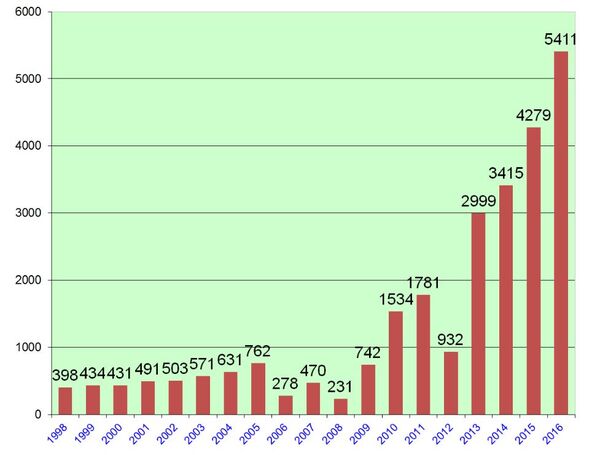
The number of published expatriates for the quarter was 1,058, bringing the total number of published expatriates in 2015 to 4,279.  The total for the year breaks last year's record number of 3,415 published expatriates. The number of expatriates for 2015 is a 25% increase over 2014 and a 42% increase over 2013 (2,999).  For a discussion of how the IRS compiles the data, see these posts: missing names, source of data.

The escalation of offshore penalties over the last 20 years is likely contributing to the increased incidence of expatriation.

We have been tracking expatriation since 2009 based on the information that the IRS has published quarterly. Until now, we have not had a reliable source of expatriation data for years prior to 1998. We recently discovered a report published in 1995 by the Joint Committee on Taxation titled "Issues Presented By Proposals To Modify The Tax Treatment Of Expatriation." The report contains a table (on page 7) with the number of individuals who have renounced their U.S. citizenship each year from 1962 to 1994 (based on State Department data).

We have created several graphs which reflect the latest expatriation data. The graph above is based solely on IRS data and shows the number of published expatriates per year since 1998. The graphs below show data going back to 1962 by incorporating State Department data.

For our prior coverage of expatriation, see all posts tagged Expatriation.

1962_2015

Expats_per_decade


^ed 

2016 Fourth Quarter Published Expatriates – New Annual Record - International Tax Blog

2016 Fourth Quarter Published Expatriates – New Annual Record - International Tax Blog
Imma gonna have to look into this asap!! 

2016 Fourth Quarter Published Expatriates – New Annual Record

2016 q4 annual

Today the Treasury Department published the names of individuals who renounced their U.S. citizenship or terminated their long-term U.S. residency ("expatriated") during the fourth quarter of 2016.

The number of published expatriates for the quarter was 2,365, bringing the total number of published expatriates in 2016 to 5,411.  The total for the year breaks last year's record number of 4,279 published expatriates.  The number of expatriates for 2016 is a 26% increase over 2015 and a 58% increase over 2014 (3,415).  For a discussion of how the IRS compiles the data, see these posts: missing names, source of data.

The escalation of offshore penalties over the last 20 years is likely contributing to the increased incidence of expatriation.

We have created two graphs which reflect the latest expatriation data. The graph above is based solely on IRS data and shows the number of published expatriates per year since 1998. The graph below shows data going back to 1962 by incorporating State Department data.  For the source of the State Department data, see this post.

Interestingly, Boris Johnson, the UK Secretary of State for Foreign and Commonwealth Affairs (and former Mayor of London), appears to be on the list.  Also, Alexander Friedrich Antonius Johannes Von Hohenzollern, also known as Alexander, Hereditary Prince of Hohenzollern appears to be on the list.

For our prior coverage of expatriation, see all posts tagged Expatriation.

1962-2016 expatriation


^ed 

2016 Fourth Quarter Published Expatriates – New Annual Record - International Tax Blog

2016 Fourth Quarter Published Expatriates – New Annual Record - International Tax Blog
Can I sell my citizenship on eBay? 

Pretty sure no one would notice for quite some time. 

I could totally swing this.  I have total shut in potential.  

All I need to do is keep crying about Comcast and my Smart TV!! 

Hmmmm... 


Americans Renouncing Citizenship at Record High

It all goes back to the Civil War.

The number of Americans renouncing their citizenship rose to a new record of 5,411 last year, up 26 percent from 2015, according to the latest government data.

Why?

It all goes back to the Civil War, and to a tax meant to deter potential draft dodgers from leaving the U.S. Today, the goal is to make sure that all of the income of U.S. citizens, whether they live and work in the U.S. or not, is reported to the Internal Revenue Service.

The rules got trickier in 2010, when, in an effort to cut down on tax evasion, the Foreign Account Tax Compliance Act (fabulously, Fatca, for short) was passed into law. It basically said foreign institutions holding assets for U.S. citizens had to report the accounts or withhold a 30 percent tax on them if the information wasn't provided. That led some foreign banks to shy away from opening accounts for expats.

Since Fatca came into being, annual totals for Americans renouncing citizenship have reached their four highest historic levels, as shown in the chart below from Andrew Mitchel LLC and its International Tax Blog.

Source: U.S. Treasury Department via Andrew Mitchel LLC

Among the names on the 2016 list of those bidding adieu to the U.S. and its tax code was the U.K.'s foreign secretary, Boris Johnson, who was born in New York. Boldface names from years past (some really past) include the torch song master Josephine Baker, the actor Yul Brynner, the great soprano Maria Callas, businessmen Kenneth and Robert Dart, investor Mark Mobius, and Eduardo Saverin, a co-founder of Facebook. 


http://intltax.typepad.com/intltax_blog/2017/02/2016-fourth-quarter-published-expatriates-new-annual-record.html

2016 Fourth Quarter Published Expatriates – New Annual Record

2016 q4 annual

Today the Treasury Department published the names of individuals who renounced their U.S. citizenship or terminated their long-term U.S. residency ("expatriated") during the fourth quarter of 2016.

The number of published expatriates for the quarter was 2,365, bringing the total number of published expatriates in 2016 to 5,411.  The total for the year breaks last year's record number of 4,279 published expatriates.  The number of expatriates for 2016 is a 26% increase over 2015 and a 58% increase over 2014 (3,415).  For a discussion of how the IRS compiles the data, see these posts: missing names, source of data.

The escalation of offshore penalties over the last 20 years is likely contributing to the increased incidence of expatriation.

We have created two graphs which reflect the latest expatriation data. The graph above is based solely on IRS data and shows the number of published expatriates per year since 1998. The graph below shows data going back to 1962 by incorporating State Department data.  For the source of the State Department data, see this post.

Interestingly, Boris Johnson, the UK Secretary of State for Foreign and Commonwealth Affairs (and former Mayor of London), appears to be on the list.  Also, Alexander Friedrich Antonius Johannes Von Hohenzollern, also known as Alexander, Hereditary Prince of Hohenzollern appears to be on the list.

For our prior coverage of expatriation, see all posts tagged Expatriation.

1962-2016 expatriation


^ed 

Offshore Tax Crackdown Opens With 30% Penalties for Banks

Offshore Tax Crackdown Opens With 30% Penalties for Banks - Bloomberg
Reposted February 10, 2017


Offshore Tax Crackdown Opens With 30% Penalties for Banks

The Internal Revenue Service is about to get an unprecedented look at bank accounts and investments U.S. citizens hold abroad, through a law that is making it harder to hide assets from the tax collector.

Tomorrow, the U.S. government will start imposing 30 percent taxes on many overseas payments to financial institutions that don't share information with the IRS.

That new burden has frustrated overseas banks and U.S. expatriates. It's also created a new standard of global bank-to-government information sharing designed to throw light on often difficult-to-trace accounts.

No one knows yet how successful the law will be in combating tax evasion. Still, it allows the U.S. to scoop up data from more than 77,000 financial institutions and 80 governments about its citizens' overseas financial activities.

"I don't think anything on this scale has ever been tried before," said John Harrington, a former international tax counsel at the Treasury Department who is now a partner at Dentons in Washington. "The idea that it would go off without a hitch is sort of hard to imagine."

What led to the 2010 Foreign Account Tax Compliance Act, or Fatca, was the inability of federal tax authorities to obtain clear information about financial accounts that U.S. citizens have outside the country. That's especially important for the U.S., because unlike many other countries, it taxes citizens on their worldwide income regardless of where they actually live.

'Honor' System

"If you had an account outside of the U.S., you were pretty much on your honor to disclose that information," said Denise Hintzke, the global tax leader for Deloitte Tax LLP's Fatca practice.

In establishing the law, Congress and President Barack Obama in effect threatened to cut off banks and other companies from easy access to the U.S. market if they didn't pass along such information. The U.S. was able to leverage its status as a financial center to demand action from governments and banks in other countries.

The proposal was barely debated when Congress in 2010 passed it as a budgetary offset to a tax credit for hiring. It was projected to raise $8.7 billion in revenue over a decade.

Congress hasn't addressed it since then, although the Republican National Committee voted earlier this year in favor of repeal.

Withholding Tax

Under Fatca, U.S. banks and other companies making certain cross-border payments -- such as interest and dividends -- to foreign financial institutions must withhold a 30 percent tax if the recipient isn't providing information about its U.S. account holders.

Later phases of the law will apply to a broader set of cross-border payments, such as gross proceeds from stock sales. Many non-financial companies will be affected, too.

The law has been accompanied by a new set of regulations and definitions, creating a cottage industry of advisers and interpreters. It was supposed to start Jan. 1, 2013, which was put off until tomorrow to give taxpayers more time to comply.

Fatca prompted more than 77,000 financial institutions to register for the program to avoid the withholding tax. As a result of that compliance, the government doesn't expect to collect much direct revenue from the 30 percent levy, said a senior Treasury official who spoke on condition of anonymity to discuss planning for Fatca.

Direct Disclosure

In most cases, the law isn't being implemented as written, because foreign banks said direct disclosure to the IRS would violate local laws. The prospect of withholding spurred negotiations between the U.S. and foreign governments, and other countries saw the potential benefits of reciprocal information exchange.

"This will become a sharing, automatically, between the various countries," Hintzke said.

So far, the U.S. has reached final or provisional agreements with more than 80 jurisdictions, allowing for government-to-government information exchange or streamlined business-to-government exchanges.

The list includes jurisdictions that often are labeled as tax havens, such as the British Virgin Islands, the Cayman Islands and Guernsey. It also includes most of the world's major economies, such as Germany, Japan, Canada and the U.K.

China Agreement

Last week, the U.S. announced an agreement in principle with China, allowing payments between the two countries to avoid withholding taxes. The official said negotiations with countries such as China often take more time because they ask for more during the talks.

The development of a global information exchange happened quickly, said Manal Corwin, who helped come up with the new rules at Treasury before moving to KPMG LLP, where she is national leader of the international tax practice in Washington.

"You've got countries and businesses applauding Fatca not so much because they like its existence," she said. "It has become a way to prevent additional burdens that might have come into existence."

Some expatriates renounced their U.S. citizenship rather than tolerate the requirements under Fatca and the lack of access to local banks that are refusing American customers or placing additional restrictions on them. The broad reach of the law means that it is affecting taxpayers who have been complying with the tax code.

Renouncing Citizenship

In 2013, 2,999 Americans renounced citizenship, the highest number on record, according to Treasury data compiled by Andrew Mitchel, an international tax lawyer. The four highest totals have all occurred since Fatca became law, though the exact reasons for renunciations aren't reported.

"Fatca has been a pretty difficult blow for our U.S. expatriates," said Martin Karges, senior director in international tax at BDO USA LLP in New York. "They may be shifting money to noncompliant jurisdictions."

As the account information comes into the U.S. starting in 2015, the focus shifts to the IRS, which will use the data to guide its investigations into offshore tax evasion.

Even without Fatca in place, the U.S. has used prosecutions against Credit Suisse AG and UBS AG to glean information on Americans hiding overseas accounts.

Bankers, Lawyers

Prosecutors have charged more than 70 U.S. taxpayers and three dozen bankers, lawyers and advisers in their crackdown on offshore tax evasion. Those charged include H. Ty Warner, the billionaire creator of Beanie Babies plush toys; Igor Olenicoff, a billionaire real estate developer; and Brad Birkenfeld, a former UBS AG banker who blew the whistle on the bank.

The IRS has sponsored offshore voluntary disclosure programs since 2009 that have brought in about $6.5 billion in interest, taxes and penalties and prompted more than 45,000 Americans to reveal offshore holdings.

The tax agency has said it'll have a relatively light enforcement touch for the first two years of Fatca for financial institutions that are trying to comply.

The resource-constrained IRS is making Fatca a priority without spending too much time on "small-scale" compliance matters, Commissioner John Koskinen said in a speech at a Washington tax conference earlier this month.

In 'Shadows'

"The IRS and other enforcement agencies around the world will be able to focus on the structures and arrangements that, unfortunately but inevitably, will be devised to stay in the shadows in a new world of tax transparency," he said. "And in that new world, governments will need to work closely together to shine light into those shadowy spaces until they no longer exist."

Almost right up to the deadline, the IRS has been issuing forms and instructions and Treasury has been signing international agreements.

"We can question whether the cost is worth the benefits," Harrington said. "But there's no question there's a cost, a big one. And it's going to be ongoing too."


^ed